
Ballet Leotard Lining: What Built-In Support Really Means
Ballet leotard lining adds an inner layer, usually for coverage or a smoother finish. It does not automatically turn a leotard into a garment with a built-in bra. A front lining, an elasticated shelf, and removable cup pockets are different constructions. Knowing which one a style actually has matters more than the word “supportive” in its description.
For a dancewear buyer, the task is to match that construction to the people who will wear it. Some dancers want extra opacity. Others want padding, room for a separate bra, or an internal structure that feels secure during class. Those needs overlap, but they are not interchangeable.
The Most Useful Photo Is Often the Inside View
An exterior photograph can show a neckline, strap arrangement, and back opening. It usually cannot tell you how the inner layer is attached, where it ends, or whether it has an elasticated lower edge. Before ordering a sample advertised with built-in support, ask for a clear inside-out view of the front and back.
Look for the boundaries of the construction. Does the lining cover the whole front or only the chest? Is the lower edge free, stitched into a seam, or finished with elastic? Are there openings for removable cups? If so, are the cups included? A useful product specification answers these questions in plain language.
Jinwu’s Cross Back Ballet Leotard, for example, is described with a ruched V-neckline, camisole straps, and an open crisscross back. Those are helpful design details, but they do not establish an internal bra construction. Ask for the current lining details before presenting that style as a built-in-bra option.
What the Common Construction Terms Mean
Descriptions vary between suppliers, so use the terms below as questions to resolve on the sample. The distinction is practical: an extra fabric layer, an underbust band, and a shaped insert do different jobs.
| Construction | What to look for | What it may address | What still needs checking |
|---|---|---|---|
| Front lining | An inner layer covering part or all of the front | Opacity and the feel of the inside surface | Coverage extent, stretch, and whether any support structure is present |
| Shelf bra | An internal chest panel, commonly with an elasticated lower edge | A closer fit around the chest and underbust | Panel depth, band position, and comfort for the intended wearer |
| Removable cup pockets | Openings that hold separate shaped pads | Optional padding and a smoother outline | Whether pads are included, stay in place, and suit each size |
| Fixed cups | Shaped pieces secured within the garment | A defined internal shape | Cup position, volume, and fit across the size range |
| Separate undergarment | A bra worn beneath the leotard | The wearer’s preferred independent support | Compatibility with the neckline, armholes, and back opening |
A style can combine several of these features. A fully front-lined leotard might also have cup pockets, while another may have neither pads nor an underbust band. “Lined” should therefore be followed by a description of what the lining actually does and where it sits.
Coverage and Support Are Separate Buying Decisions
Start with the problem the dancer wants to solve. If the concern is a pale fabric showing through, investigate the lining and the garment’s opacity. If the concern is movement or a lack of security around the bust, an opacity check alone will not answer it. The wearer needs to assess the complete fit during the activities for which the leotard is intended.
Pads can change the visible outline without making the surrounding garment more secure. Likewise, a close-fitting fabric can feel firm without providing the particular support a dancer wants. Avoid assigning a support level from a product photo, fabric percentage, or the presence of removable pads.
For a studio range, offering room for different preferences can be more useful than choosing a single construction and promising it will suit everyone. Some dancers may prefer a separate bra; others may find a particular lined style comfortable on its own. The product description should make those choices easier, rather than implying that one answer applies to every body.
An Open Back Changes the Options
A low or strappy back can make a conventional undergarment visible. If that matters to the dancer or the dress code, consider it when choosing the leotard. It is much easier to select a compatible cut at the start than to make an unsuitable combination work after a group order arrives.
The back also deserves attention when reviewing an internal shelf. Ask how the internal panel is anchored and where its edges sit relative to the outer opening. Do not assume that decorative crossover straps describe the internal support arrangement. They may be important to the outer fit while leaving the inside construction unspecified.
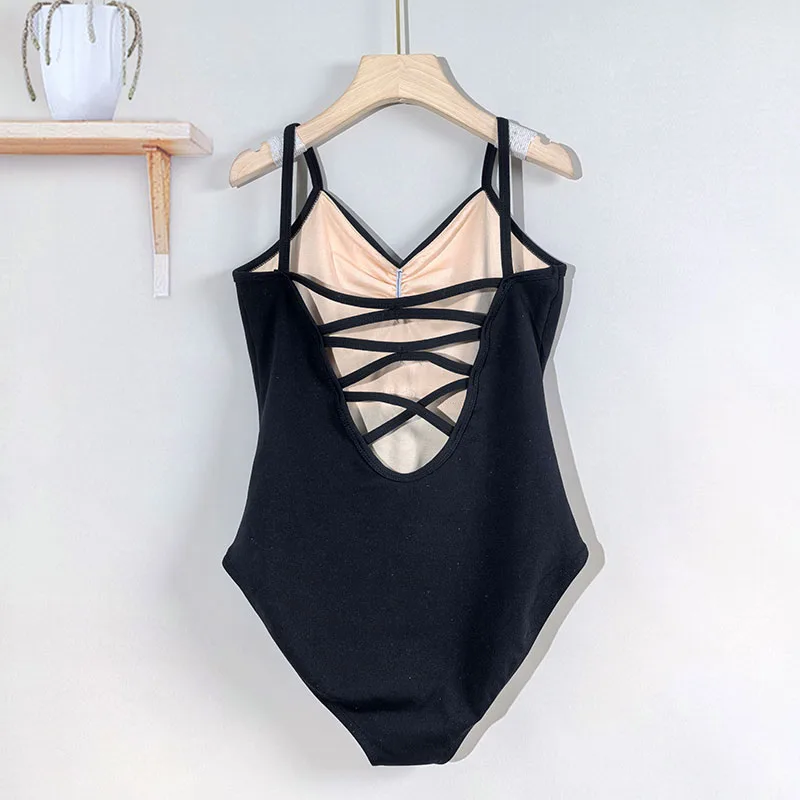
When comparing styles in the adult dancewear collection, look at both front and back views. A higher front neckline does not tell you whether a separate bra will be concealed at the back or armholes. Try the intended combination together.
Fit the Inside, Not Just the Outside
A leotard can look right from the outside while the inner panel sits too high, feels shallow, or pulls at its lower edge. Ask the wearer to describe that inner fit separately. Where an elasticated shelf is present, check that its lower edge settles in the intended position and stays comfortable as the arms move.
Do not solve every problem by choosing a smaller outer size. That may increase tension through the shoulders and torso without correcting the cup or shelf proportions. If the outer body fits but the internal construction does not, another style or a different inner design may be the better route.
For a retailer or private-label buyer, review more than one point in the proposed size range. The same cup shape or panel depth should not be assumed to work across every outer size. Ask the supplier how the internal pieces change with the garment size, and use samples to check the explanation.
Keep feedback specific. “The lower edge moves upward when the arms are raised” gives a developer something to investigate. “Needs more support” leaves several possible causes unresolved. The important distinction is between an observation from a real fitting and a general preference stated before a sample exists.
Does a Light-Colored Leotard Need Lining?
It needs a coverage assessment; lining is one possible part of the answer. Check the actual color, fabric, fit, and intended underlayers. A sample in black cannot establish the opacity of the same design in white or pale pink.
Review the garment at rest and during normal movement in representative lighting. Look for the edge of the lining as well as the coverage it provides. A short inner panel can create a visible boundary, especially when its color or texture differs from the body fabric. If that boundary is unacceptable for the design, discuss the extent and material of the lining.
There is no single lining color that disappears on every wearer. Assess the proposed combination rather than relying on a generic “nude” label. The goal is a result suitable for the intended users and dress requirements, not simply a second layer on the specification sheet.
The dancewear fabric guide explains how the outer fabric and lining should be evaluated together. Here, the key point is that an acceptable fabric swatch does not settle the fit or visibility of the finished inner construction.
Include the Inner Construction in the Care Review
Before approving a lined style, agree its intended care routine and inspect the complete garment afterward. Check whether the inner layer twists, becomes visible at an opening, or pulls differently from the outer fabric. For removable pads, follow the supplied instructions and check that the openings remain usable.
Where formal laundering evidence is needed, ISO 6330:2021 provides domestic washing and drying procedures for textile testing. Agree the relevant procedure with the supplier or laboratory. The standard is a testing reference, not proof that this or any other listed leotard has passed a particular test.
Care wording should match the garment actually supplied. Instructions for a plain unlined leotard may not suit a version with pads or extra internal components. If the construction changes during development, revisit the care information before printing labels or publishing a product page.

Say Exactly What the Customer Will Receive
A clear description might specify a full front lining, an elasticated shelf, or pockets supplied without pads—provided those details have been confirmed. Each is more useful than an unexplained promise of built-in support. Add an inside photograph when that photograph helps a shopper understand the construction.
Keep outer style details separate from inner features. A ruched neckline, a high back, or wide straps may influence a buyer’s choice, but none should be used as a substitute for information about lining or cups. If a feature varies by size or color, state the variation where customers select their option.
For a development inquiry, send the preferred outer style and describe the inner requirement separately. Explain whether the priority is coverage, removable padding, compatibility with a separate bra, or a particular shelf arrangement. Ask Jinwu to confirm the available construction and sample options before treating that requirement as an agreed product feature.
Conclusion
Ballet leotard lining, cups, and shelf bras should be described as the constructions they are. Start with the wearer’s need, inspect the inside, and assess the complete garment in motion. Clear details help customers choose—and keep a wholesale specification from promising more than the sample delivers.
FAQ
Do all ballet leotards have built-in support?
No. Some have only an outer fabric layer, some have lining, and others include a shelf or cups. Confirm the exact style instead of assuming that “dancewear” implies a particular inner construction.
Are removable pads always included with cup pockets?
No. A pocket describes the place where a pad can sit. The product specification should say whether inserts are supplied and whether that arrangement changes by size.
Does full front lining mean the back is lined too?
No. “Full front” describes the front area. Ask for the extent of the back lining separately, especially when a design includes mesh or an open back.
Can a separate bra be worn under a lined leotard?
It can be an option if the combined fit is comfortable and the undergarment works with the leotard’s openings. Check both garments together and follow the studio’s dress requirements.
Can lining be added after a style has been approved?
It may be possible, but it changes the construction. Ask the supplier to review the alteration and approve the revised garment before applying it to the order.