
Forro de leotardo de ballet: lo que realmente significa el soporte incorporado
El forro de ballet leotardo agrega una capa interna, generalmente para una cobertura o un acabado más suave. No convierte automáticamente un leotardo en una prenda con un sostén incorporado. Un forro frontal, un estante elástico y bolsillos de copa extraíbles son diferentes construcciones. Saber cuál es realmente un estilo que tiene más que la palabra “apoyador” en su descripción.
Para un comprador de ropa de baile, la tarea es hacer coincidir esa construcción con las personas que la usarán. Algunos bailarines quieren una opacidad extra. Otros quieren relleno, espacio para un sostén separado o una estructura interna que se sienta segura durante la clase. Esas necesidades se superponen, pero no son intercambiables.
La foto más útil es a menudo la vista interior
Una fotografía exterior puede mostrar un escote, una disposición de correa y una apertura trasera. Por lo general, no puede decirle cómo se une la capa interna, dónde termina o si tiene un borde inferior elástico. Antes de pedir una muestra anunciada con soporte incorporado, solicite una vista de adentro hacia afuera clara del frente y la parte posterior.
Busque los límites de la construcción. ¿El forro cubre todo el frente o solo el cofre? ¿El borde inferior está libre, cosido en una costura o terminado con elástico? ¿Hay aberturas para tazas extraíbles? Si es así, ¿las tazas están incluidas? Una especificación útil del producto responde a estas preguntas en un lenguaje sencillo.
Jinwu Maillot de ballet con espalda cruzada, por ejemplo, se describe con un escote en V fruncido, correas de camisola y una espalda cruzada abierta. Esos son detalles útiles de diseño, pero no establecen una construcción interna de sujetador. Pregunte por los detalles del revestimiento actual antes de presentar ese estilo como una opción de sujetador incorporado.
Qué significan los términos de construcción comunes
Las descripciones varían entre proveedores, por lo que utilice los términos que se indican a continuación como preguntas para resolver la muestra. La distinción es práctica: una capa de tela adicional, una banda debajo del busto y una inserción en forma hacen diferentes trabajos.
| imaginación | que buscar | lo que puede abordar | Lo que todavía necesita comprobar |
|---|---|---|---|
| Forro frontal | una capa interior que cubre parte o todo el frente | Opacidad y la sensación de la superficie interior | extensión de cobertura, estiramiento y si hay alguna estructura de soporte presente |
| sujetador de estante | Un panel de pecho interno, comúnmente con un borde inferior elástico | Un ajuste más cercano alrededor del pecho y debajo del busto | Profundidad del panel, posición de la banda y comodidad para el usuario previsto |
| Bolsillos de copa extraíbles | Aberturas que contienen almohadillas de forma separada | Relleno opcional y un contorno más suave | Si se incluyen las almohadillas, permanecen en su lugar y se adaptan a cada tamaño |
| Copas fijas | Piezas con forma aseguradas dentro de la prenda | una forma interna definida | Posición, volumen y ajuste de la copa en todo el rango de tamaño |
| prenda interior separada | Un sujetador que se usa debajo del leotardo | El apoyo independiente preferido del usuario | Compatibilidad con el escote, sisas y abertura trasera |
Un estilo puede combinar varias de estas características. Un maillot completamente de frente también puede tener bolsillos para copa, mientras que otro puede no tener almohadillas ni una banda debajo del busto. Por lo tanto, “lineado” debe ir seguido de una descripción de lo que realmente hace el revestimiento y dónde se encuentra.
La cobertura y el soporte son decisiones de compra por separado
Comience con el problema que el bailarín quiere resolver. Si la preocupación es una tela pálida que se muestra, investigue el forro y la opacidad de la prenda. Si la inquietud es el movimiento o la falta de seguridad alrededor del busto, un control de opacidad por sí solo no responderá. El usuario necesita evaluar el ajuste completo durante las actividades a las que se pretende el leotardo.
Las almohadillas pueden cambiar el contorno visible sin hacer que la prenda circundante sea más segura. Asimismo, una tela ajustada puede parecer firme sin proporcionar el apoyo particular que quiere un bailarín. Evite asignar un nivel de soporte de una foto del producto, porcentaje de tela o la presencia de almohadillas extraíbles.
Para una gama de estudio, ofrecer espacio para diferentes preferencias puede ser más útil que elegir una sola construcción y prometer que se adaptará a todos. Algunos bailarines pueden preferir un sujetador separado; otros pueden encontrar un estilo de forro en particular cómodo solo. La descripción del producto debería hacer que esas opciones sean más fáciles, en lugar de implicar que una respuesta se aplica a cada cuerpo.
Una espalda abierta cambia las opciones
Una espalda baja o con tiras puede hacer visible una prenda interior convencional. Si eso le importa a la bailarina o al código de vestimenta, considérelo al elegir el leotardo. Es mucho más fácil seleccionar un corte compatible al principio que hacer que una combinación no adecuada funcione después de que llegue un pedido de grupo.
La espalda también merece atención al revisar un estante interno. Pregunte cómo se ancla el panel interno y dónde se encuentran sus bordes en relación con la abertura exterior. No asuma que las correas decorativas para cruces describan la disposición de soporte interno. Pueden ser importantes para el ajuste exterior mientras dejan la construcción interior sin especificar.
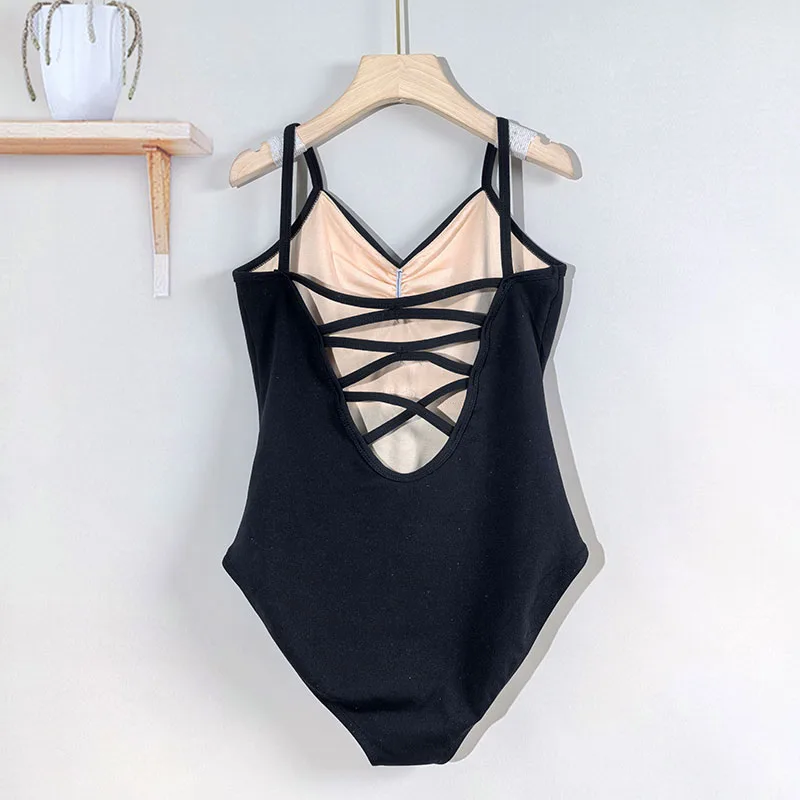
Al comparar estilos en el Colección de ropa de baile para adultos, mira las vistas tanto frontal como posterior. Un escote delantero más alto no le dice si un sostén separado se ocultará en la espalda o en las sisas. Prueben juntos la combinación prevista.
Encaja el interior, no solo el exterior
A leotard can look right from the outside while the inner panel sits too high, feels shallow, or pulls at its lower edge. Ask the wearer to describe that inner fit separately. Where an elasticated shelf is present, check that its lower edge settles in the intended position and stays comfortable as the arms move.
Do not solve every problem by choosing a smaller outer size. That may increase tension through the shoulders and torso without correcting the cup or shelf proportions. If the outer body fits but the internal construction does not, another style or a different inner design may be the better route.
For a retailer or private-label buyer, review more than one point in the proposed size range. The same cup shape or panel depth should not be assumed to work across every outer size. Ask the supplier how the internal pieces change with the garment size, and use samples to check the explanation.
Keep feedback specific. “The lower edge moves upward when the arms are raised” gives a developer something to investigate. “Needs more support” leaves several possible causes unresolved. The important distinction is between an observation from a real fitting and a general preference stated before a sample exists.
Does a Light-Colored Leotard Need Lining?
It needs a coverage assessment; lining is one possible part of the answer. Check the actual color, fabric, fit, and intended underlayers. A sample in black cannot establish the opacity of the same design in white or pale pink.
Review the garment at rest and during normal movement in representative lighting. Look for the edge of the lining as well as the coverage it provides. A short inner panel can create a visible boundary, especially when its color or texture differs from the body fabric. If that boundary is unacceptable for the design, discuss the extent and material of the lining.
There is no single lining color that disappears on every wearer. Assess the proposed combination rather than relying on a generic “nude” label. The goal is a result suitable for the intended users and dress requirements, not simply a second layer on the specification sheet.
los Guía de tela de ropa de baile explains how the outer fabric and lining should be evaluated together. Here, the key point is that an acceptable fabric swatch does not settle the fit or visibility of the finished inner construction.
Include the Inner Construction in the Care Review
Before approving a lined style, agree its intended care routine and inspect the complete garment afterward. Check whether the inner layer twists, becomes visible at an opening, or pulls differently from the outer fabric. For removable pads, follow the supplied instructions and check that the openings remain usable.
Where formal laundering evidence is needed, ISO 6330:2021 provides domestic washing and drying procedures for textile testing. Agree the relevant procedure with the supplier or laboratory. The standard is a testing reference, not proof that this or any other listed leotard has passed a particular test.
Care wording should match the garment actually supplied. Instructions for a plain unlined leotard may not suit a version with pads or extra internal components. If the construction changes during development, revisit the care information before printing labels or publishing a product page.

Say Exactly What the Customer Will Receive
A clear description might specify a full front lining, an elasticated shelf, or pockets supplied without pads—provided those details have been confirmed. Each is more useful than an unexplained promise of built-in support. Add an inside photograph when that photograph helps a shopper understand the construction.
Keep outer style details separate from inner features. A ruched neckline, a high back, or wide straps may influence a buyer’s choice, but none should be used as a substitute for information about lining or cups. If a feature varies by size or color, state the variation where customers select their option.
For a development inquiry, send the preferred outer style and describe the inner requirement separately. Explain whether the priority is coverage, removable padding, compatibility with a separate bra, or a particular shelf arrangement. Ask Jinwu to confirm the available construction and sample options before treating that requirement as an agreed product feature.
idea de narración
Ballet leotard lining, cups, and shelf bras should be described as the constructions they are. Start with the wearer’s need, inspect the inside, and assess the complete garment in motion. Clear details help customers choose—and keep a wholesale specification from promising more than the sample delivers.
preguntasrán el
Do all ballet leotards have built-in support?
No. Some have only an outer fabric layer, some have lining, and others include a shelf or cups. Confirm the exact style instead of assuming that “dancewear” implies a particular inner construction.
Are removable pads always included with cup pockets?
No. A pocket describes the place where a pad can sit. The product specification should say whether inserts are supplied and whether that arrangement changes by size.
Does full front lining mean the back is lined too?
No. “Full front” describes the front area. Ask for the extent of the back lining separately, especially when a design includes mesh or an open back.
Can a separate bra be worn under a lined leotard?
It can be an option if the combined fit is comfortable and the undergarment works with the leotard’s openings. Check both garments together and follow the studio’s dress requirements.
Can lining be added after a style has been approved?
It may be possible, but it changes the construction. Ask the supplier to review the alteration and approve the revised garment before applying it to the order.