Plus Size Ballet Leotard Fit: Bust, Girth and Coverage
Choose a plus size ballet leotard by comparing your measurements with the chart for that exact style, then check its coverage and movement in person. Bust, waist, hips and torso girth all matter. If they point to different sizes, ask about the cut or a suitable adjustment rather than assuming the largest measurement can be solved by going up one size.
A comfortable leotard should let you concentrate on class. It does not need to make every dancer look the same, and discomfort is not evidence that a body is wrong for ballet. The practical question is whether the garment provides the length, width, neckline and leg coverage its wearer needs.
Understand what the size label leaves out
Terms such as XL and 3XL identify positions within a supplier’s own range. They do not tell you the body measurements, torso proportion or coverage of a particular leotard. Compare the actual chart before transferring a familiar label from another garment.
Ask whether the chart describes body measurements or measurements of the finished garment. Those are different kinds of information. A flat garment width, for example, cannot be read as a body circumference without knowing how it was measured and how the garment is intended to fit.
Use the supplier’s measurement diagram and keep units consistent. Record bust, waist and hips, together with the torso or girth measurement the supplier requests. Clarify the tape route for girth rather than guessing whether “length” means a vertical measurement or a loop around the torso.
ISO 8559-1:2017 provides definitions for clothing-related body measurements; ISO records it as confirmed in 2026. It does not assign a universal fit to a retail size label. For a buyer and manufacturer, its relevance is consistent measurement terminology, not a guarantee that a garment labelled 3XL will fit a particular person.
When your measurements point to different sizes
It is common for a size chart to give a clearer answer at one part of the body than another. The useful next step is to identify that mismatch. If the bust falls within one size but the hip measurement falls elsewhere, tell the supplier both values and ask which styles or adjustments they recommend.
Consider an illustrative fitting: the larger size accommodates the hips, but its neckline gaps during a forward bend. Ordering still larger would not address the neckline. The next comparison should examine the cut and proportions, not simply continue up the size list.
| What happens at the fitting | What to compare next | Useful question for the supplier |
|---|---|---|
| Hips fit, but the upper body is loose | Bust-to-hip proportions, neckline and strap placement | Is there another cut with the required hip room and a closer upper fit? |
| Width feels acceptable, but the garment pulls vertically | Torso girth, body length and where the tension appears | Can you compare the girth requirement with this style’s chart? |
| Bust fits, but the leg opening cuts in | Leg-line shape, opening dimensions and elastic application | Would a different leg cut or adjusted opening address this area? |
| Neckline coverage changes when the arms lift | Body length, front coverage and the fit through the upper torso | Which measurements or photographs would help assess this movement? |
| Every area feels excessively tight | The complete chart, intended fit and possible measurement error | What size or style should be tried before discussing an alteration? |
These observations narrow the conversation; they do not diagnose a pattern fault from a distance. Several features can contribute to the same symptom. Keep notes on where the garment feels restrictive or loose, and compare one clearly defined change at a time.
Separate torso length from body width
A longer torso and a fuller body are different fit requirements, although one dancer may need accommodation for both. A larger size may add width and length in a fixed relationship. That relationship may not match the wearer’s proportions.
If the width is comfortable but the leotard pulls between shoulder and crotch, check the girth measurement and how the garment sits before changing the size. Conversely, if there is excess fabric through the torso, extra length may not be helpful even when more room is needed elsewhere.
Do not treat longer straps as a universal remedy. Lowering the body of the garment can also lower its neckline or change the position of the back opening. Adjustable straps, where present, are a feature to evaluate within the whole fit; they do not establish that every torso-length problem is adjustable.
For a made-to-order discussion, ask which dimensions can be changed and how the manufacturer will confirm the result. A request for “more room” is too vague to distinguish extra hip width, added body length or a different leg opening. Supply the relevant measurements and describe the problem in ordinary language.
Choose coverage deliberately
Front, back and leg coverage are separate choices. A higher neckline may suit someone who wants more coverage at the chest, while an open back may suit another dancer’s preference. Neither choice follows automatically from being plus size.
Look at the side and back views before choosing. Pay attention to how far the leg line rises, where the back opening begins and which areas are sheer. Product photographs can show the design, but they cannot establish how that design will sit on every body.
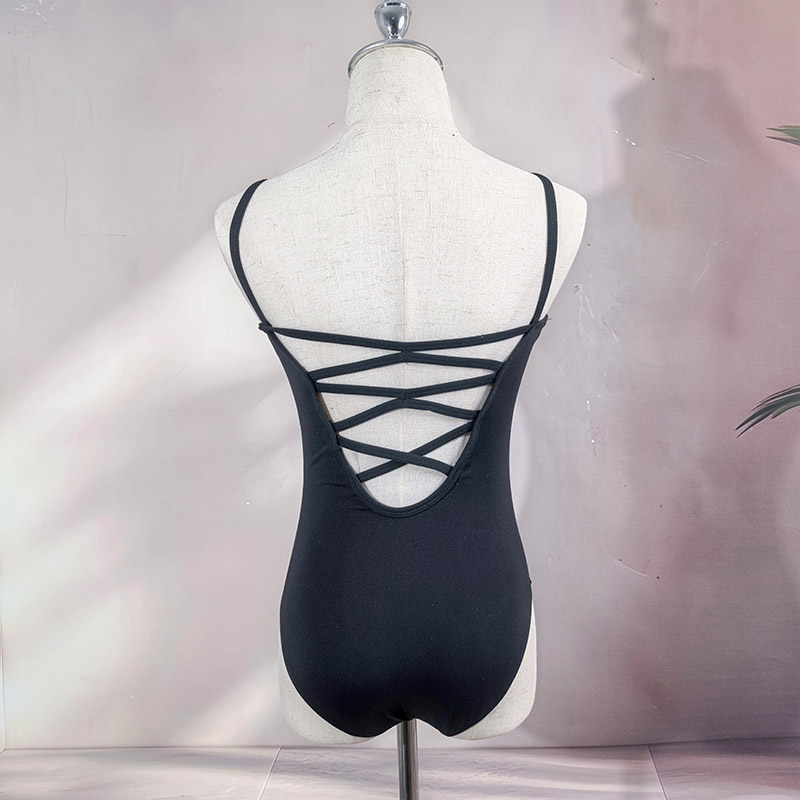
At the fitting, check the coverage while sitting, bending and raising the arms, within comfortable movements. If the wearer continually adjusts a neckline or leg opening, record the direction it moves and when. That is more useful feedback than calling the whole garment unflattering.
Where a school has a uniform policy, confirm the permitted design first. Within that requirement, discuss a cut that respects the dancer’s coverage preferences. A skirt should not be the default answer to an uncomfortable leotard underneath it.
Check support as a separate requirement
A close-fitting leotard and an internal support structure are not the same thing. Stretch fabric can make a garment feel secure, but fibre content alone does not establish bust support, cup capacity or the presence of a shelf bra.
Ask what is inside the finished garment: front lining, a separate shelf, cups or another construction. Then check whether that construction suits the wearer. If a separate bra is preferred, examine the neckline, armholes and back opening with that bra in place, subject to any applicable class rules.
An open cross-back style deserves particular attention because the back of a conventional bra may remain visible. That is a compatibility question, not a reason to promise that narrow crossed straps will provide equivalent support.
The dedicated guide to leotard lining and built-in support explains these constructions in more detail. For this fitting, establish the wearer’s preferred support arrangement before judging the neckline and upper-body fit.
Make the fitting useful
Try the leotard with the underlayers intended for class and allow time to move. Start with ordinary actions such as sitting, walking, reaching and bending, then add familiar class movements that the dancer can perform comfortably. The aim is to observe garment behaviour, not to put the wearer through a performance test.
Check whether the straps stay in place, whether the neckline maintains the desired coverage and whether the leg openings feel comfortable. Note seams or elastic that draw attention during movement. The wearer’s own feedback is essential; a garment that looks smooth in a photograph may still be uncomfortable.
Look at opaque panels under the lighting in which the garment will be used. Distinguish intentional mesh from an area expected to provide coverage. Avoid promising opacity from a black colour name or a fabric-weight figure alone.
If trying two sizes or cuts, use the same simple movements and record the difference. For example, “the second cut stays in place when I reach overhead” explains more than “the second one is better.” Follow the seller’s fitting and return conditions while evaluating a sample.
What Jinwu’s published size range establishes
Jinwu’s Cross Back Ballet Leotard page lists adult sizes XS–5XL and custom-size enquiries. It also identifies a ruched V-neck, camisole straps, an open crossed back and a body fabric of 75% polyamide and 25% spandex. Those are concrete starting points for comparing the style.
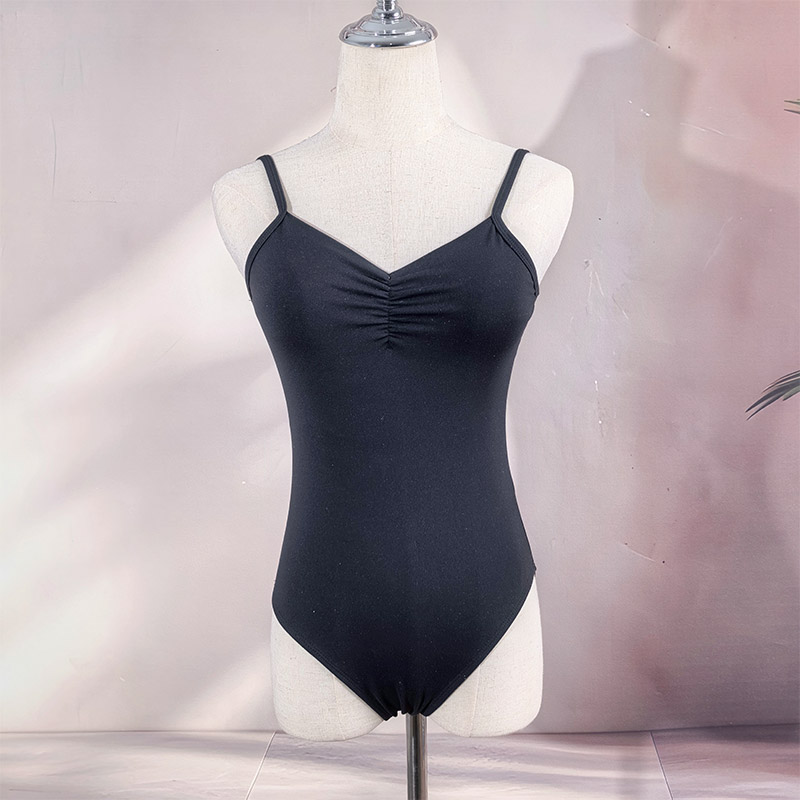
The listed range does not reveal the measurement interval for each size, prove that every size is immediately available or confirm a fit for every bust-to-hip proportion. The photographs illustrate construction; they are not a documented fit trial across the extended range.
Before ordering, request the style-specific body chart, clarification of girth measurement and the internal lining or support details. If the standard proportions appear unsuitable, ask what custom-size work is possible and how a sample would be approved. Do not assume that an available custom-size service means every requested design change is already established.
For a focused enquiry, send your measurements and coverage preferences with the Cross Back product reference. Describe any fit issue from a previous garment without relying on its size label alone. Retail buyers can instead provide their intended customer measurement range and request representative samples.
Build clearer information for retail customers
A plus size ballet leotard collection needs useful information at each size offered. Publish the measurements and explain how they were taken. Where a style differs in neckline, leg cut or internal construction, describe that difference instead of copying one fit paragraph across the range.
Arrange sample reviews across the proposed range rather than relying only on one middle size. Record the wearers’ relevant measurements, their chosen sizes and the observations they agree to share. Do not present a single successful fitting as evidence that the whole range has been validated.
Keep product photography honest. Show the garment from enough angles to explain its cut, and add model measurements or sample size only when those details are known and approved for publication. A generic model image should not be relabelled as an extended-size fit demonstration.
Finally, give customers a clear route to ask about a mismatch between measurements. “Consult the chart” is incomplete help when the chart points to several sizes. A useful reply addresses the style, the particular proportion and what can be checked next.
Conclusion
A good fit comes from matching the leotard’s proportions and construction to its wearer. Use the size chart as a starting point, then evaluate length, coverage, support and movement together. Where the standard cut does not work, ask a precise question about another style or an achievable adjustment.
FAQ
Does 5XL mean the same thing across suppliers?
No universal body measurements can be inferred from that label. Compare the chart for the exact style, its measurement definitions and the intended fit.
Should I automatically size up if I have a fuller bust?
Compare all relevant measurements first. A larger size may add unwanted room elsewhere. Ask about a more suitable upper-body cut and assess the intended support arrangement during the fitting.
Can a leotard be too short even if the waist fits?
Yes. Waist circumference and torso length describe different dimensions. Check the requested girth measurement and explain where the vertical pulling occurs before choosing another size.
Is a higher spandex percentage proof of a better fit?
No. Fibre content does not establish the finished garment’s dimensions, coverage, support or behaviour on a particular body. Compare construction and a suitable sample as well as the material description.
What should I send with a custom-size enquiry?
Provide the product reference, measurements taken by the supplier’s method, preferred coverage and the specific fit problem to solve. Ask which changes are feasible and how the revised sample will be checked.