Lunghezza della gonna da balletto: misura il capo, quindi controllalo in classe
The right ballet skirt length depends on where the skirt is worn, what the class or choreography requires and how the garment moves on the dancer. Start with the teacher’s instructions, confirm the measurement from the intended waist position and assess the full outfit. A label such as short, knee-length or rehearsal length is not a precise specification.
For schools and retail buyers, the aim is to turn a visual preference into something that can be measured and checked. That means naming the front, back and any longer side points, rather than assuming one number or one product photograph describes the whole hem.
Check which class or dance the skirt is for
A skirt permitted in one class may not be appropriate for another. The requirement can concern visibility, the type of exercise or the way the skirt is used in a dance. Ask for the actual instruction before choosing a length from a general balletwear guide.
As a specific example, Southern California Ballet’s dress code lists a semi-sheer skirt at mid-thigh or shorter for its intermediate-to-company ballet students, while its character-class section specifies a knee-length or mid-calf character skirt. Those are different requirements within one school, not interchangeable descriptions of a universal ballet skirt.
Skirts can also be part of an exercise rather than just an additional layer. In its 2018 explanation of ballet uniform, The Lewis Foundation of Classical Ballet describes young students learning arm positioning while holding a skirt edge. That example shows why a teacher may care about the skirt’s reachable edge as well as its appearance.
For a performance, let the costume brief define the intended silhouette. Do not shorten a skirt simply because a shorter one is familiar from weekly class. Equally, a performance photograph is not proof that the same garment meets the school’s training policy.
Ballet skirt length starts at the wearing position
Identify where the waist opening is designed to sit. The same skirt will appear longer if it slips lower and shorter if it is pulled higher. That is a change in wearing position, not a change in the garment’s measured length.
For a separate skirt, assess the waistband over the leotard and tights intended for use. Confirm that it stays in the agreed position before evaluating the hem. If the waistband moves, investigate its fit rather than compensating by changing the length first.
For an attached skirt, the starting point is the attachment seam on the dress or skirted leotard. Its position is part of the garment’s construction. Check the bodice fit at the same time, because a bodice that sits incorrectly can change where the skirt begins on the dancer.
la leotard-and-tutu pairing guide covers the interaction between two separate garments. For a length decision, the key is to establish that stable starting point before asking for a longer or shorter sample.
Measure front, back and any deliberately longer points
Ask the supplier how its published length is measured. Does the number begin at the top of the waistband or below it? Is it the center front, center back or longest point? A measurement without those definitions is difficult to compare with another skirt.
Use the agreed method and units. For a garment measurement, arrange the skirt without stretching it unless the specification explicitly calls for a different condition. For a body reference, identify the desired hem position on the wearer separately. Keep those two types of measurement clearly labeled.
| Skirt configuration | Measurements to clarify | Why one length may be insufficient |
|---|---|---|
| Even hem with a separate waistband | Starting point, center front and center back | The waistband may be included or excluded in the stated number |
| Longer back hem | Front and back lengths, plus the transition at the sides | The shortest and longest areas serve different visual roles |
| Asymmetric hem | Named side or panel points and the longest drop | A single maximum does not describe the shorter side |
| Wrap skirt | Front, back, overlap and intended tying position | How it wraps affects the visible opening and hem position |
| Skirt attached to a dress | Attachment seam to hem at agreed points | Total dress length includes the bodice and cannot substitute for skirt length |
Keep a simple sketch or marked photograph with the numbers. The purpose is not to make the document elaborate. It is to ensure that the person making the sample measures the same part of the garment that the buyer intends to approve.
Read length together with shape and material
Two skirts with the same measured drop can look and move differently. Fullness, panel shape, openings and the way the fabric falls all contribute to the result. Compare complete samples rather than treating length as a standalone measure of coverage or movement.
A flowing skirt and a layered tutu also need different descriptions. One may fall close to the body while another projects outward. The tutu dress construction guide explains those shape distinctions. Avoid using the vertical length of one style to predict the silhouette of the other.
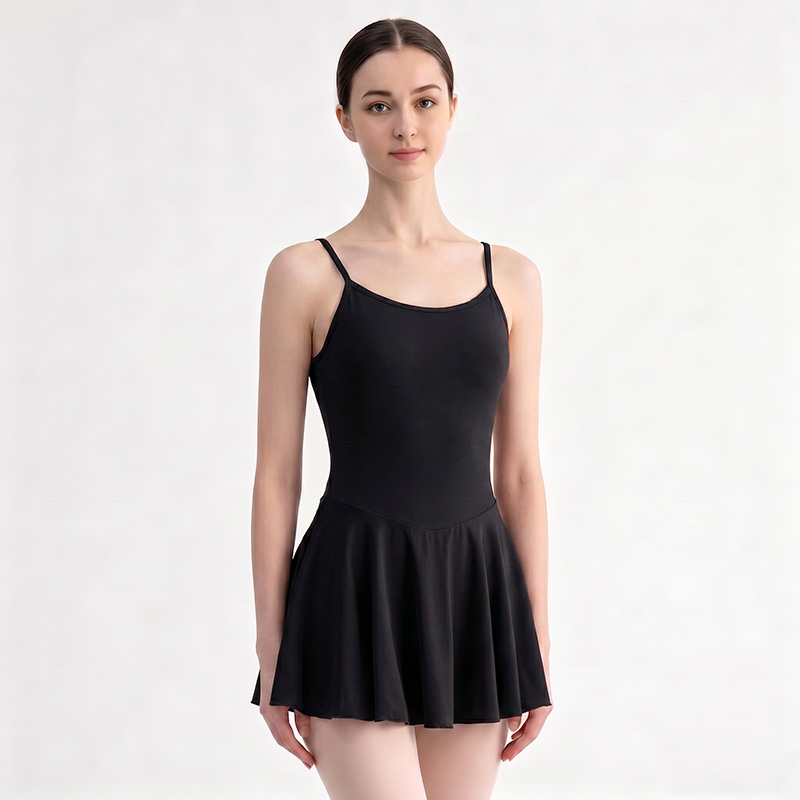
Jinwu Abito da ballo a canotta is shown with an attached flowing skirt. Its photographs help identify the construction, but they do not supply a verified skirt-length measurement for every size. Request that information for the actual sample under consideration.
For a chiffon ballet skirt or a mesh ballet skirt, confirm the actual material rather than inferring it from transparency in an image. A fabric photograph can suggest a visual effect; it cannot establish composition, the measured drop or how the finished hem will behave in your chosen size.
Check the skirt through the movements it must allow
Begin with a standing view so the intended hem position is clear. Then have the teacher choose movements relevant to the class or dance. Observe how the skirt lifts, falls and returns, and whether the waistband or attachment remains where expected.
Look from more than one side. A longer back panel may be unobtrusive from the front, while an opening or overlap may become more visible during a turn. The dancer should also report whether the skirt requires repeated adjustment or feels in the way.
If the dance includes holding the skirt, ask the teacher to assess the edge the dancer will actually use. Do not assume the longest point is the correct grip point. Reach, skirt fullness and the intended arm position need to be considered together.
For partnered work or choreography with close spacing, assess the complete costume in that context under appropriate supervision. A standing photograph cannot show every contact or clearance issue. The relevant question is whether the garment works for the planned movement, not whether it looks like a familiar length category.
Record the observed issue before proposing a change. “The back hem catches during this transition” gives the costume team something specific to investigate. “Make it shorter” may overlook an issue with fullness, an opening or the way the garment is being worn.
Fit a group without assuming identical proportions
Matching size labels do not guarantee that a skirt lands at the same point on every dancer. Body proportions and wearing position matter. For a coordinated group, decide whether the aim is one specified garment length or a similar visual hem position on each wearer.
Those are different ordering instructions. If the school wants a consistent visual line, discuss how the supplier or costume professional will achieve it and how any individual adjustments will be recorded. Do not leave that expectation implicit in a group photograph.
Avoid using total height alone to produce a universal skirt-length recommendation. It does not describe every relevant proportion or the intended waist position. Combine the supplier’s size information with the measurement and fitting method agreed for the garment.
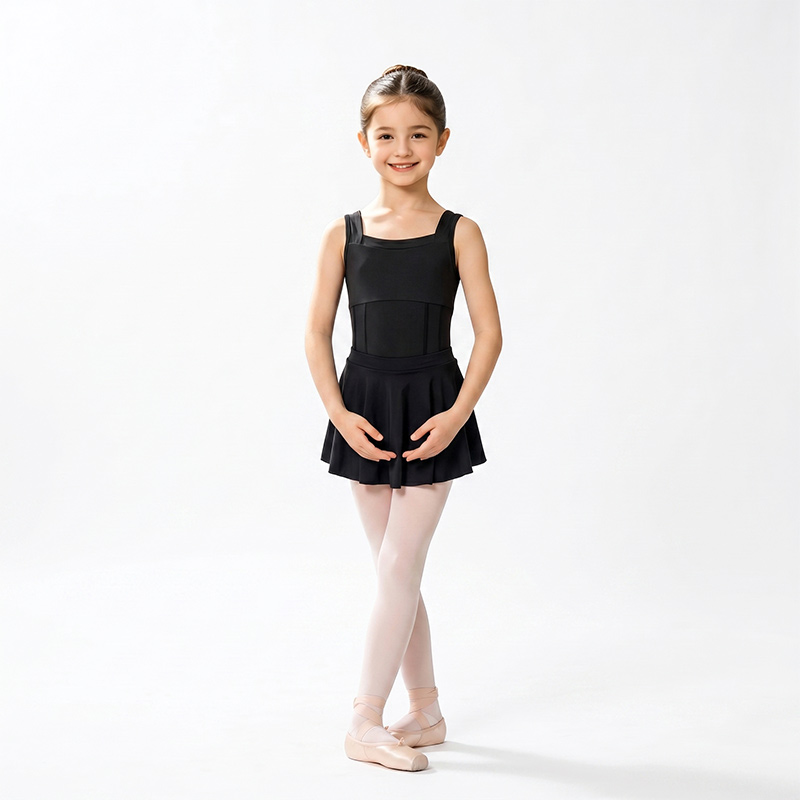
Jinwu Body per balletto includes a separate pull-on skirt and lists children’s size labels 80–160. Those labels should not be treated as verified skirt lengths or automatically interpreted as body-height measurements. Ask for the chart definitions and skirt measurements for the sizes needed.
Specify what the next sample should change
Send the existing style reference, sample size and marked length points. Identify the intended wearer and class or performance use. If the request is a revision, state the current measurement and the desired result without changing the measurement method between them.
Keep the waist position and silhouette in the brief. Ask whether a length change affects the panel shape, overlap or intended hem finish. An alteration that sounds simple in centimeters may still require the maker to review how the skirt is constructed.
Do not assume every finished skirt can be shortened cleanly. Decoration, a shaped edge or the construction of the hem may affect the available alteration. Have the supplier or costume professional assess the actual garment before cutting or removing any finish.
Approve the revised sample in the agreed wearing position and repeat the relevant movement check. Comparing only the new measurement can miss an unintended change in the way the skirt falls.
Explain the length so customers can compare it
Publish the measurement definition beside the value, including the size measured and whether the waistband is included. For an asymmetric or longer-back design, provide the relevant additional measurements. A short explanation can prevent customers from comparing unlike numbers.
Use photographs that show the front and back hem clearly. Avoid relying only on a pose in which the skirt is lifted or spread. A movement photograph is useful alongside a settled view, but it should not be the only evidence of length.
Where measurements change by size, provide the appropriate information rather than presenting one sample’s figure as universal. Keep any suggested use conditional on the customer’s own school or production requirements.
Ask Jinwu about the skirt measurements for your selected style with the required sizes, wearing position and front/back hem references. Those details make a length request much easier to assess than “a little longer than the photo.”
conclusione
Ballet skirt length is a relationship between the garment, the wearer and the intended movement. Define the starting point, measure the relevant parts of the hem and check the sample in use. That gives a school or retailer a specification that can be explained and repeated.
FAQ
Does ballet skirt length include the waistband?
Not necessarily. Ask how the supplier measures it and keep that definition with the number. A top-edge measurement and a measurement from below the band are not directly interchangeable.
Can I roll the waistband to make a skirt shorter?
Do not rely on that as the approved fit unless the garment and teacher’s instructions allow it. Rolling changes the wearing arrangement and may not remain stable through the dance.
Is knee-length always suitable for ballet class?
No. The school may require a shorter skirt, a specific style or no skirt. A knee-length character-class garment is not automatically appropriate for a different ballet lesson.
Which length should I list for an asymmetric skirt?
List the measurements needed to explain its shape, with clearly named points. Include the longest drop and the relevant shorter front, back or side measurement rather than one unlabeled value.
Can a product photo tell me exactly where the hem will fall?
No. The model’s proportions, garment size, pose and wearing position affect the image. Use the defined measurements and a relevant fitting to assess your own result.