
Ballet Leotard Riding Up? A Practical Fit Check for Children
A ballet leotard riding up does not always mean a child needs the next size. The body may be too short, the leg opening may not suit the wearer, or a loose garment may be shifting during movement. Start by noticing where the pull begins. Repeatedly tugging the fabric back into place tells you there is a fit problem; it does not tell you which measurement to change.
This guide is for parents, teachers, and dancewear buyers investigating an uncomfortable leotard already in use. For measuring a class before placing an order, use the separate children’s leotard size chart guide. Here, the aim is to work out what has gone wrong and make one useful adjustment at a time.
Start Where the Pulling Starts
Ask the child to put the leotard on normally, then leave it alone for a moment. Check that the shoulder straps are not twisted and that the fabric has been drawn into place rather than left bunched around the hips. If the garment is uncomfortable before any movement, there is little value in asking the child to dance through the problem.
Listen to the description. “It hurts at the shoulders,” “the edge digs into my leg,” and “it slips when I bend” point to different things. Young children may simply call all three “too tight.” Let them show where the discomfort is, without treating their reaction as something they need to get used to.
The observations below are starting points, not a diagnosis from a photograph. More than one can occur in the same garment.
| What you notice | What to investigate | A useful comparison |
|---|---|---|
| Shoulders pull while the lower body moves upward | Insufficient body length or an incompatible overall proportion | Compare the torso measurement with the style’s own chart |
| The leg edge feels tight but the shoulders are comfortable | Leg opening size, elastic tension, or the cut around the seat | Try another cut as well as an adjacent size |
| Loose fabric gathers before the garment shifts | Excess room or a shape that does not settle on the wearer | Compare a closer-fitting option without introducing new pressure |
| The problem began after a period of comfortable wear | Growth, changes in the garment, or a different underlayer | Compare current measurements and care history |
| Only one piece differs from others in the same style and size | A possible variation in that garment | Check it against an unworn reference piece |
Torso Length Can Explain a Fit That Looks Right Across the Chest
A leotard runs from the shoulders through the crotch and back again. Enough room around the chest does not guarantee enough length along that route. A child with a relatively long torso can therefore find a garment tight vertically even when its width seems reasonable.
Check how the supplier defines its measurement. A torso girth is commonly measured in a loop from a shoulder, down the front, through the crotch, and back to the starting point. It is not the same as a straight shoulder-to-waist length. Follow the diagram supplied for the particular chart, keep the tape comfortable, and let a parent or guardian handle the measurement privately.
If the chart gives only age or height, ask for the missing fit guidance. Do not invent a conversion from height to torso girth. Two children of similar height can need different proportions. Also check whether the figures describe the child’s body or the garment laid flat; those numbers cannot be compared directly.
For clothing developers, ISO 8559-1:2017 is a reference for body-measurement definitions. It does not provide a universal Jinwu size chart or decide which leotard will fit an individual child. The practical requirement is that the buyer and supplier mean the same thing when they discuss a measurement.
A Different Leg Opening May Be More Useful Than More Room Everywhere
When the shoulder and torso fit seem comfortable, look more closely at the lower edge. The height of the leg opening, the amount of seat coverage, and the elastic finish all affect how that part of the garment sits. A child may dislike the cut even when the nominal size matches the chart.
Compare the leotard at rest with its position after a few ordinary movements. Does the edge stay where it started? Does the child immediately reach to pull it down? Ask whether the problem is pressure from the edge or a feeling that the garment no longer covers as expected. Those are more useful observations than judging the fit solely by wrinkles.
Jinwu’s Wide Strap Ballet Leotard has broad shoulder straps and a gathered front neckline. It is one possible style to assess within the children’s range, but those upper-body features do not establish that its leg opening will suit every child. Evaluate the actual sample as a complete garment.
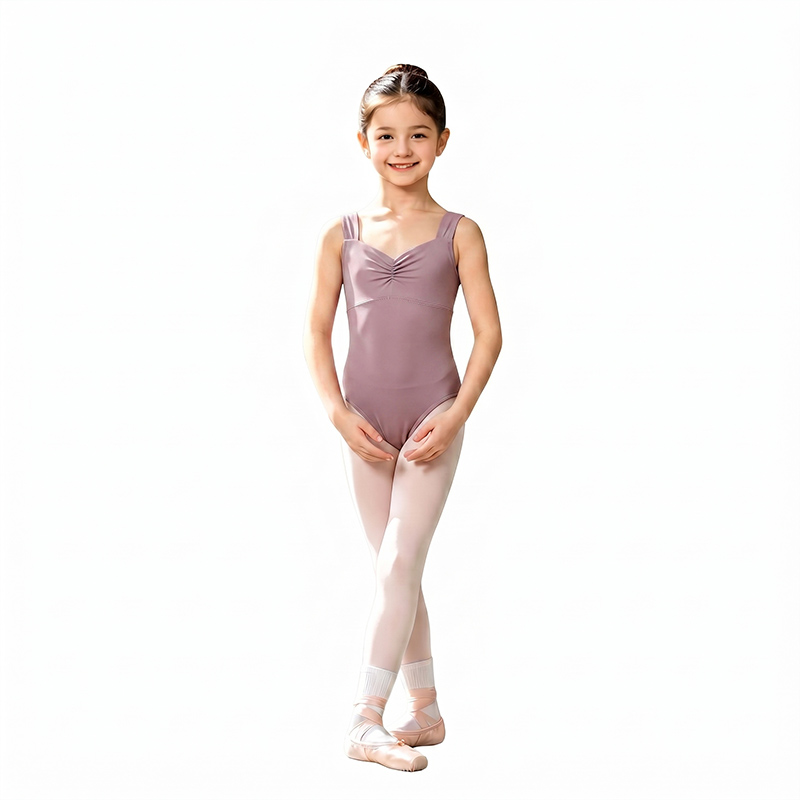
Do not cut into the elastic or shorten the straps as an experiment on a garment you may need to exchange. An alteration changes the fit elsewhere and makes the original problem harder to assess. Ask the seller about the appropriate next step while the garment is still in its supplied condition.
Use Familiar Movements, Not an Endurance Test
A fitting does not need an elaborate routine. Once the child is comfortable standing, ask for a few familiar class movements: raising the arms, a gentle plié, and a simple bend or step appropriate to their experience. A teacher can help choose movements the child already knows. Stop if the garment hurts or the child is uncomfortable.
Watch what happens without repeatedly resetting the fabric between each movement. If the leotard stays comfortable only when someone keeps pulling it down, it has not passed a useful fit check. Equally, small temporary folds during a bend are not by themselves evidence that the size is wrong.
Check the complete class combination. Tights or other permitted underlayers may change how the garments sit together. Keep those items consistent when comparing two leotards, so that you are not changing several things at once. A skirt should not be used to hide a fit problem underneath.
For a sample review, record a short description such as “comfortable at rest; lower edge shifts after arms are raised.” The purpose is to identify a repeatable observation, not to grade the child’s body against a garment. Fit feedback should lead to a better clothing choice.
When Should You Try a Larger Size?
Try an adjacent size when the measurements and the fitting both suggest the current garment is too small. Then check the whole fit again. Extra body length is useful only if the neckline, straps, and leg openings remain secure and comfortable.
If the larger size removes the upward pull but leaves the shoulders slipping or the neckline gaping, it has exchanged one problem for another. That is a reason to compare a different style or ask for advice on body proportions. Continuing to size up is unlikely to answer a mismatch between length and width.
The same reasoning applies to growing room. A garment bought for a future body still has to work for the child wearing it today. Avoid treating a particular extra measurement as a universal allowance: stretch, pattern, and the position of the openings differ between styles. Current comfort and stable coverage are the more useful checks.
If a school requires one exact style, speak to the teacher before substituting another. The school may already have fitting guidance or an approved alternative. Explain the specific difficulty, rather than simply reporting that the uniform “doesn’t fit.”
What If the Leotard Used to Fit?
Begin with what changed. Remeasure the child using the same method and compare the result with the original chart. Check whether the problem started gradually, after laundering, or when a new pair of tights was introduced. The timing will not prove the cause, but it narrows the questions worth asking.
Inspect the garment itself. Look for a twisted strap, a seam that has become uncomfortable, or a leg edge that no longer lies as it did. Compare it with another piece of the same style if one is available. A new size may be appropriate after growth, while an isolated construction problem needs a different response.
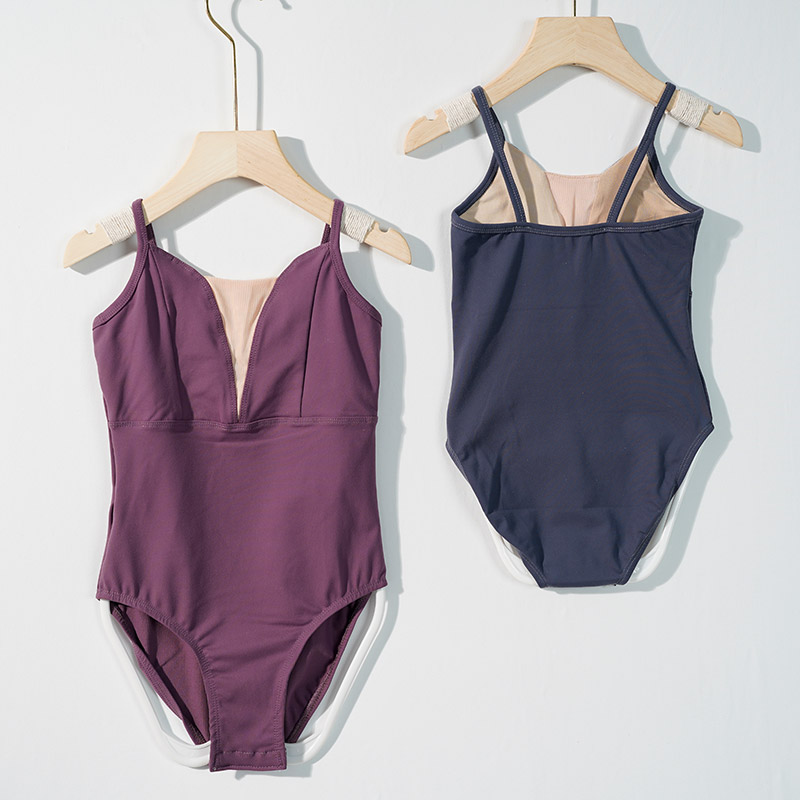
Follow the care instructions supplied with the garment. Deliberately stretching a tight leotard or using heat to shrink a loose one is not a reliable way to create the right proportions. It can also make a useful comparison with the original sample impossible.
Turn Repeated Complaints into Useful Supplier Feedback
One child struggling with one size calls for an individual fitting. Similar complaints across several children may justify reviewing the style or size range. Keep those situations separate before asking the supplier to change a pattern.
A school or retailer can keep a brief record of the style, labeled size, relevant body measurements, location of the discomfort, and result of trying an adjacent size. Avoid collecting unnecessary personal information or fitting photographs. A clear written description is often enough to begin the conversation.
Check whether the issue is concentrated in one size, one delivery, or one body proportion. For example, if an adjacent size consistently solves the length but becomes loose across the upper body, discuss that pattern with the supplier. This is an illustrative review method, not evidence of a fault in any Jinwu style.
For help selecting from the kids’ dancewear collection, send Jinwu the style reference and a concise description of the fit problem. Include the measurement method and the sizes already compared. That gives the team a more useful starting point than requesting a generally “stretchier” leotard.
Conclusion
When a ballet leotard rides up, locate the pull before changing the size. Check torso length, the leg opening, and the way the garment behaves during a few familiar movements. A successful replacement should resolve the discomfort without creating looseness elsewhere.
FAQ
How tight should a child’s ballet leotard be?
It should sit close enough to stay in place without painful pressure or repeated adjustment. Check comfort at the shoulders, torso, and leg openings, then repeat the check during normal class movements.
Can a leotard be too large and still ride up?
A loose or poorly matched cut can shift during movement. Look for where excess fabric gathers and compare the fit with another size or shape instead of assuming every upward movement means the garment is too small.
Will wider straps solve a short torso fit?
Not necessarily. Strap width changes one part of the upper construction; it does not automatically add body length. Compare the torso fit and the position of all openings on the actual garment.
Should I leave extra growing room in a leotard?
Some flexibility in fit may be practical, but the garment must stay comfortable and secure now. If extra room causes slipping or gaping, that size is not a useful choice for current classes.
Should I use the same size in every leotard style?
Use the chart and fit guidance for each style. A familiar size label is a starting point, not a guarantee that the body length, neckline, or leg opening will match another garment.