
Choosing a Ballet Rehearsal Leotard for a Long Day in the Studio
A ballet rehearsal leotard should stay comfortable and in place as the day changes: barre, repeated passages, time waiting for a cue, then another run. Start with a cut that fits without constant adjustment, check it with the layers the dancer actually wears, and choose a garment whose care requirements fit the rehearsal schedule. An attractive neckline is worth very little if someone keeps pulling it back into position.
For a studio purchasing a rehearsal range, the useful question is not which style looks best on every dancer. It is which small selection gives the group a workable choice without losing the consistency the director needs. The following checks help separate a promising fitting-room impression from a leotard people will willingly wear again tomorrow.
Start with the rehearsal day, not the product photograph
A morning technique class followed by afternoon rehearsals puts different demands on an outfit from a short run of one scene. Establish whether dancers stay in the same clothing throughout, whether skirts are required, and whether the schedule includes costume fittings or a change of studio. Ask the teacher or rehearsal director about permitted colors and cuts before narrowing the selection.
A ballet class leotard may also work for rehearsal, but permission to wear it in class does not settle every rehearsal requirement. A choreographer may need a clear view of the waist or shoulder line; a costume team may want dancers to bring particular underlayers. Keep those instructions attached to the actual session rather than treating them as universal ballet rules.
For an illustrative studio schedule with barre, ensemble rehearsal and an afternoon fitting, write down what changes between those activities. The answer might be a removable skirt and a spare leotard, rather than one heavily detailed garment intended to serve every purpose. This is a planning example, not a claim about a particular company’s rehearsal practice.
A ballet rehearsal leotard must work beyond the first fitting
Check fit with the dancer’s normal tights and any permitted support garment. A smooth standing silhouette is a starting point. Watch what happens when the dancer raises both arms, bends, turns and repeats a familiar phrase. The neckline, seat and leg openings should not need resetting after every movement.
Pay particular attention to the path from shoulder to crotch. If the garment feels short through the body, tightening or repositioning the straps may only shift the discomfort elsewhere. If the body is loose, going down a size can create a new problem at the shoulders or hips. Compare the manufacturer’s measurements and try an alternative cut before deciding that the dancer simply needs a tighter garment.
For a long torso, strap length alone is not an answer: the body pattern and its stretch also matter. For a shorter torso, loose fabric is not automatically evidence that the whole garment is too large. Record where the excess or tension occurs. Our adult leotard sizing guide can help organize measurements, but the rehearsal trial still needs to happen in the selected style.
Do not ask dancers to tolerate persistent discomfort to complete an assessment. A useful trial identifies a problem; it does not require someone to keep wearing the garment after the problem is clear.
Choose straps and sleeves by what the dancer notices
A camisole ballet leotard leaves the arms uncovered and gives relatively little fabric to manage under an outer layer. That can suit dancers who dislike sleeves during repeated arm work. However, a narrow strap that feels unobtrusive on one person may press or slide on another. A crossed back changes the strap arrangement; it does not guarantee that the garment cannot move.
A tank cut provides more coverage around the shoulder area. It is worth trying when a dancer prefers that coverage or needs a different relationship with an underlayer. Wider straps do not, by themselves, establish support or comfort. Their position and the armhole shape still need to match the wearer.
Sleeves are another preference to test rather than rank. Check the underarm and sleeve edge with arms raised, then with the outer layer the dancer uses between runs. If the sleeve catches or folds repeatedly, compare a different sleeve shape or an uncovered arm. Do not assume a mesh sleeve will feel cooler simply because it looks open.
| Detail | When it is worth considering | What the rehearsal trial must resolve |
|---|---|---|
| Camisole straps | The dancer prefers uncovered shoulders and arms | Whether the straps stay positioned without digging in |
| Tank shoulders | More shoulder coverage is preferred or required | Whether the armhole and strap edges remain comfortable in repeated movement |
| Crossed back | The dancer likes this back arrangement and it fits permitted underlayers | Whether the crossing and strap tension suit the individual torso |
| Higher neckline and sleeves | Additional coverage fits the session’s requirements | Whether neck, underarm and sleeve edges remain unobtrusive |
| Removable rehearsal layer | The outfit needs to change between activities | Whether putting it on or removing it disturbs the leotard underneath |
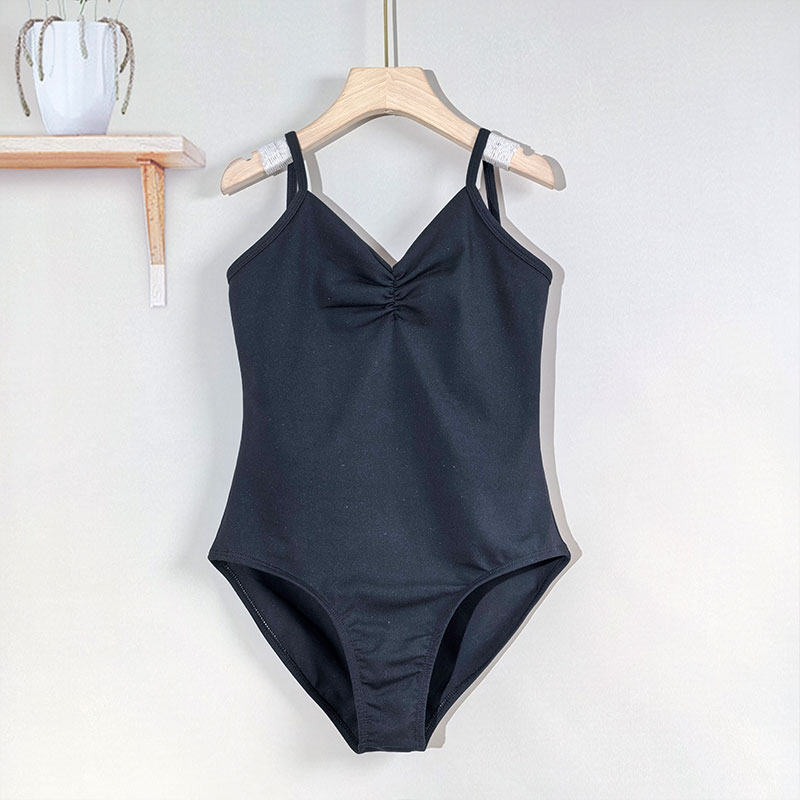
Jinwu’s Cross Back Ballet Leotard is one concrete camisole reference: its published specification lists 75% polyamide and 25% spandex, 230 GSM fabric, and adult sizes XS–5XL. The ruched front and crossed straps give buyers specific construction details to assess. Those specifications do not establish all-day comfort for every dancer.
Read the fabric description, then examine the lining
Fiber percentages help identify a material, but they do not tell you exactly how the completed leotard will feel through a rehearsal. Knit construction, fabric weight, lining, seams and the amount of stretch used on the body all belong in the assessment. Likewise, GSM means grams per square meter: it describes fabric mass per unit area, not a temperature rating or a measure of comfort.
Ask what is lined and where the lining ends. Check the inside at the chest, waist and leg openings, including any edge that sits against the wearer. Ballet leotard lining can change coverage and the feel of the garment; adding more layers is not automatically an improvement for someone who already finds the outfit cumbersome.
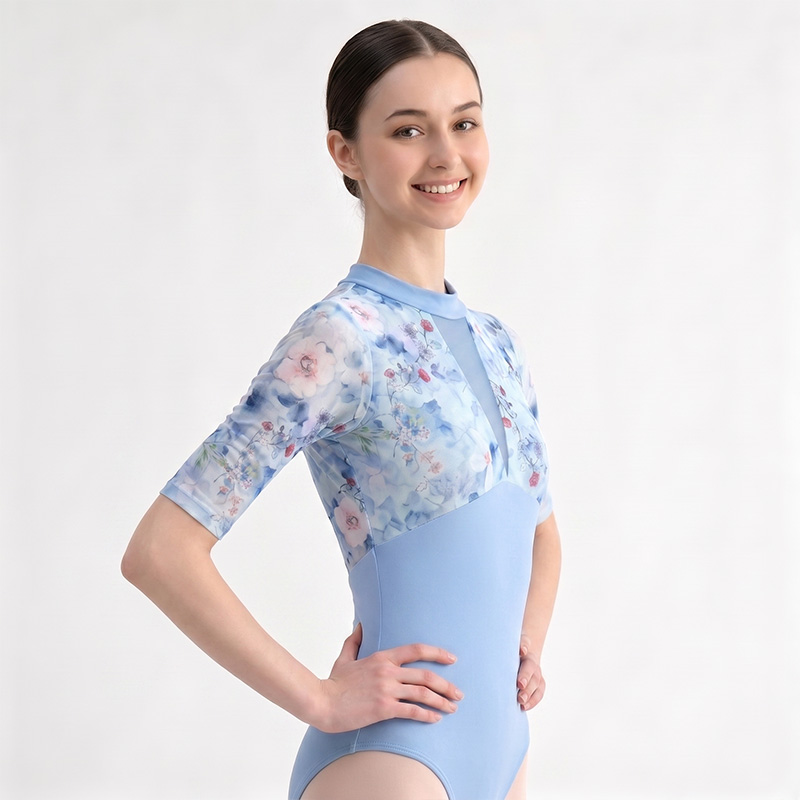
For a different construction reference, Jinwu’s High Neck Floral Ballet Leotard lists a 75% nylon, 25% spandex body and 100% polyester mesh, with a high neckline and elbow-length sleeves. Compare that coverage arrangement with the camisole example. Do not turn the fiber list into an unsupported claim about drying speed, moisture management or temperature control.
If a purchasing brief requires a measurable fabric property, request evidence for the proposed material and construction. A marketing phrase such as “breathable” is not a substitute for an agreed test method and result. For ordinary selection, the dancer’s observations remain useful, provided they are described as personal wear feedback rather than laboratory proof.
Rehearse the changes between layers
Try the complete combination before buying a group order. Put the wrap or sweatshirt on, remove it, add the rehearsal skirt and repeat a short phrase. Notice whether straps move while an outer layer comes off or whether a waistband pulls at the leotard. A garment that works alone may behave differently under another piece.
Where an underlayer is needed, assess its straps, edges and coverage with the chosen neckline and back. A low back may expose a support garment that a higher back would cover. That is a compatibility question, not a reason to tell a dancer to forgo the support they need. Discuss permitted options with the person responsible for the session.
Distinguish ordinary rehearsal clothing from what is required under a costume. A skin-tone leotard is not automatically an appropriate costume underlayer: its neckline, straps, leg openings and seams may still show. For a dress rehearsal, take the actual costume team’s instructions and check the combination with the costume. Color alone cannot settle the choice.
Ask for observations at different points in the session
A single end-of-day score tends to hide the useful detail. Ask what the dancer noticed at the start, after repeated movement and when changing layers. Keep the trial within a normal permitted rehearsal rather than inventing a demanding endurance test.
“The left strap needed adjusting whenever I removed my top” gives the buyer something to investigate. “Uncomfortable” does not yet identify whether the issue is strap placement, torso length, a seam or an incompatible underlayer. Note the size and exact garment version alongside the observation, so feedback from two different samples is not accidentally combined.
Look for patterns across dancers without dismissing an individual problem. If several wearers describe the same sleeve edge, examine that construction. If one person has a different torso proportion and cannot find a comfortable size, an alternative cut may be more useful than changing the garment for everyone.
After a revision, return to the activity that exposed the issue. A new photograph of a stationary sample cannot demonstrate that a slipping strap or uncomfortable armhole has been resolved. The approval decision should answer the original complaint in plain language.
Make the next day’s clean garment part of the choice
A rehearsal wardrobe needs a realistic washing and drying routine. Read the complete garment’s care label, including restrictions that may come from mesh, trim or other components. The American Cleaning Institute’s laundry guidance recommends sorting by color, fabric and care instructions, and choosing appropriate wash and dry settings. It does not establish a care program for a particular Jinwu model.
Plan rotation around the method the selected garment actually permits. If it cannot be washed and fully dried between sessions using that method, provide an additional clean garment or select another suitable option. Do not promise an overnight turnaround from the fiber name or use extra heat to force the schedule.
Keep a spare available where changing is practical. Its value is simple: a dancer can change after a spill or before another session without depending on the original garment being ready immediately. The number needed depends on the rehearsal calendar and laundry arrangements; there is no useful universal quantity for every studio.
Give a studio range enough choice to fit real people
For group purchasing, decide which details truly need to match. A shared color with two permitted cuts may serve the rehearsal purpose better than requiring one neckline across the whole group. If the director needs one uniform cut, resolve the fit exceptions before treating the order as ready.
Send the supplier the session requirements, approved cut or cuts, size breakdown, lining questions and the observations that mattered during trials. Keep the approved garment version identifiable. Ask what is currently available rather than assuming that every photographed color and size can be supplied together.
To discuss suitable options with Jinwu, share your rehearsal routine and sample feedback, including the layers dancers use and where the current clothing needs adjustment. That gives the team a more useful starting point than a request for the “most comfortable” leotard without any context.
Conclusion
Choose a rehearsal leotard around the day it has to handle. Resolve fit first, compare straps and sleeves on the wearer, test the complete outfit, and allow for proper care between sessions. The strongest choice is the one dancers can work in without repeatedly thinking about their clothing.
FAQ
Should I buy a looser leotard for a long rehearsal?
Do not size up solely because the session is longer. Excess fabric or loose straps can create their own adjustments. Compare measurements and cuts, then choose the size that remains comfortable and secure in movement.
Can the same leotard work for class and rehearsal?
Yes, if both sessions permit it and it works with the required layers and movement. Check any different instructions for costume fittings, dress rehearsals or particular choreography before relying on one outfit.
Does a higher spandex percentage guarantee better comfort?
No. The finished fabric, pattern, lining and fit all affect the wearing experience. Compare actual garments; a fiber percentage alone cannot rank two leotards for sustained comfort.
Should a rehearsal leotard match the dancer’s skin tone?
Only when the session or costume requirements call for it. Everyday rehearsal does not inherently require a skin-tone garment. When it is needed beneath a costume, check the individual shade and visible garment edges with that costume.
Can one dancer approve the rehearsal range for an entire studio?
One wearer’s feedback can identify useful issues but cannot represent every size and body proportion. Include wearers relevant to the proposed size range, and keep individual feedback separate from conclusions about the whole order.