
Come leggere una tabella delle dimensioni di un body per adulti senza indovinare
An adult leotard size chart is useful only when you know what its numbers describe. Check whether they are body measurements or finished-garment measurements, confirm the units and use the chart for the exact style you are ordering. Compare the full set of measurements before choosing a sample; a familiar clothing size is not enough.
The confusing part often comes after measuring. Your bust may fall in one row, your hips in another, and your torso measurement somewhere else. That does not make the measurements wrong. It means the chart needs interpretation, and sometimes the supplier needs to recommend a different size or cut.
First, find out what the adult leotard size chart measures
A body-size chart describes the intended wearer. A garment specification describes the item itself, often measured flat and relaxed. Those tables serve different purposes, even if both have columns labelled bust, waist or hip.
For a stretch leotard, a relaxed garment measurement can be smaller than the corresponding body measurement by design. That difference is often called negative ease. It is not a reason to subtract an invented percentage from your body measurements. The amount depends on the garment design and material; ask the supplier to explain its own specification.
A further distinction is width versus circumference. A flat width across the front of a garment is not the same measurement as the distance all the way around a body. Doubling a width may be appropriate for a defined garment measurement, but only when the supplier confirms how and where that width is taken. It does not turn the result into a recommended body size.
| Information on the chart | What it usually describes | What to clarify before using it |
|---|---|---|
| Body bust, waist and hip ranges | Measurements of the intended wearer | The exact measuring positions and whether range boundaries overlap |
| Relaxed garment width | A distance across the item laid flat | The measurement line, whether the number is a half-width and whether any tension is applied |
| Garment length | A specified distance on the leotard | The start and end points; do not substitute body height |
| Torso girth or body loop | A body measurement following the supplier’s defined route | The route shown in its diagram; do not confuse it with waist circumference |
| XS–5XL or another size range | Available size labels | The measurements assigned to each label for this product |
If the table does not identify its measurement type, resolve that first. Comparing carefully taken body measurements with an unexplained garment table can produce a very confident but incorrect size choice.
Match the measuring method to the label
Use the supplier’s illustrated instructions where available. The words “girth,” “torso” and “length” are not interchangeable. In leotard fitting, a torso-loop measurement commonly follows a route over a shoulder, through the crotch and back to the starting point. The supplier’s diagram should establish the precise route required for its chart.
For bust, waist and hip measurements, confirm the anatomical position the chart expects. A favourite trouser waistband may sit below the point intended by a body-waist measurement. The underbust is also a different measurement from the fullest bust. Writing the location beside the result helps prevent these mix-ups.
ISO 8559-1:2017 sets out anthropometric definitions for clothing-related body measurements. Its purpose illustrates why measurement definitions matter. It does not provide a universal adult leotard conversion chart or certify a supplier’s sizing.
Use a flexible tape, follow the stated method and keep the reading consistent rather than pulling the tape tighter to reach a preferred row. If you cannot take a measurement reliably, ask for help from someone you are comfortable with. Remeasure a surprising result before treating it as a fit problem.
For school purchasing, provide the same instructions to everyone. A list of numbers collected using different methods is difficult to interpret, even when all the entries are in centimetres. Record the method once and keep it with the ordering sheet.
Put every number in the same unit
Check the column headings, not just the title above the chart. Some tables mix height in centimetres with circumferences in inches. A copied spreadsheet can also lose a unit label while retaining the numbers.
One inch equals exactly 2.54 centimetres. Multiply inches by 2.54 to obtain centimetres; divide centimetres by 2.54 to obtain inches. Keep the original measurement as well as the conversion, especially when your result sits near a size boundary.
For an arithmetic example only, 35 inches equals 88.9 centimetres. That number is not a Jinwu size recommendation. If a hypothetical chart boundary were 89 centimetres, rounding the original measurement before converting could alter how the result appears relative to the boundary. Use consistent precision and ask how the supplier treats close cases.
Do not convert letter sizes with arithmetic. “M” is a label, not a unit, and a UK or US clothing size cannot be converted into a leotard label by applying the centimetre-to-inch formula. Compare the measurements assigned to those labels instead.
When your measurements span several sizes
Keep all the measurements visible. Choosing whichever row matches the bust and ignoring the torso does not resolve a disagreement; it simply hides it. Equally, automatically choosing the largest label can create a loose area elsewhere.
Ask which measurement the supplier prioritises for this cut and what its between-size guidance assumes. Include the measurements that disagree, the intended garment and the kind of fit you need. A useful question is: “My bust and hip fit your medium range, but my torso measurement is in large. Which sample should I try for this style?”
That is an illustrative question, not a universal instruction to choose medium or large. The answer depends on the actual chart, construction and wearer. A longer torso, for example, may need a different body length without needing the same increase in every circumference.
When measurements remain outside the available combination, ask whether another cut or a confirmed custom option is appropriate. Do not promise that stretchy fabric will accommodate any difference. For the broader considerations behind extended sizing, see our plus-size ballet leotard fit guide.
Use the chart for the actual leotard
A chart from a previous purchase is useful background, but it is not automatically valid for a new style. Confirm whether the supplier uses one body-size chart across the range or separate guidance for particular products. Also check whether you are looking at adult sizing rather than a child range with similar letter labels.
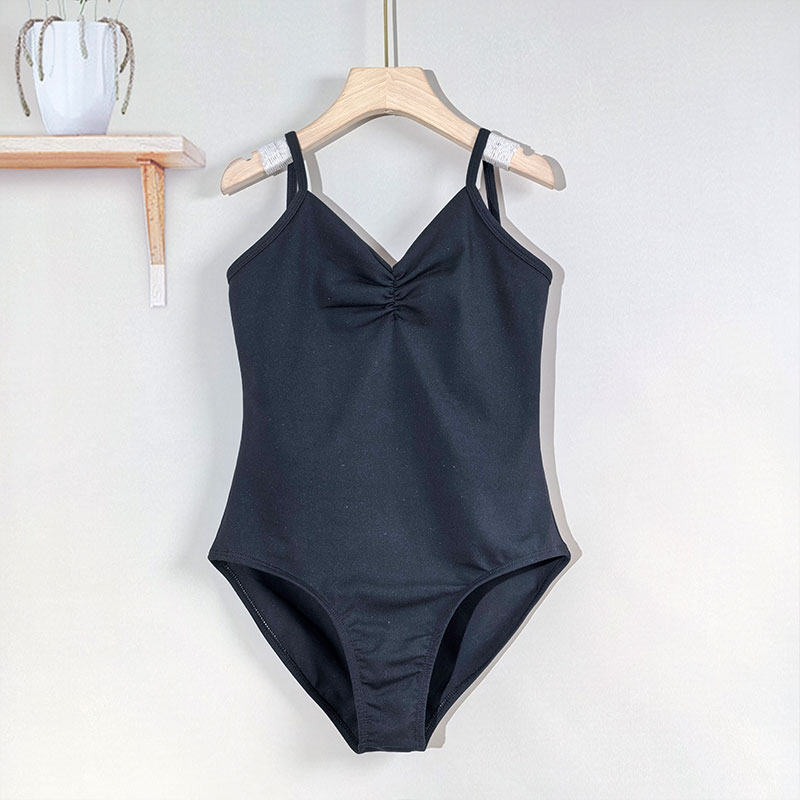
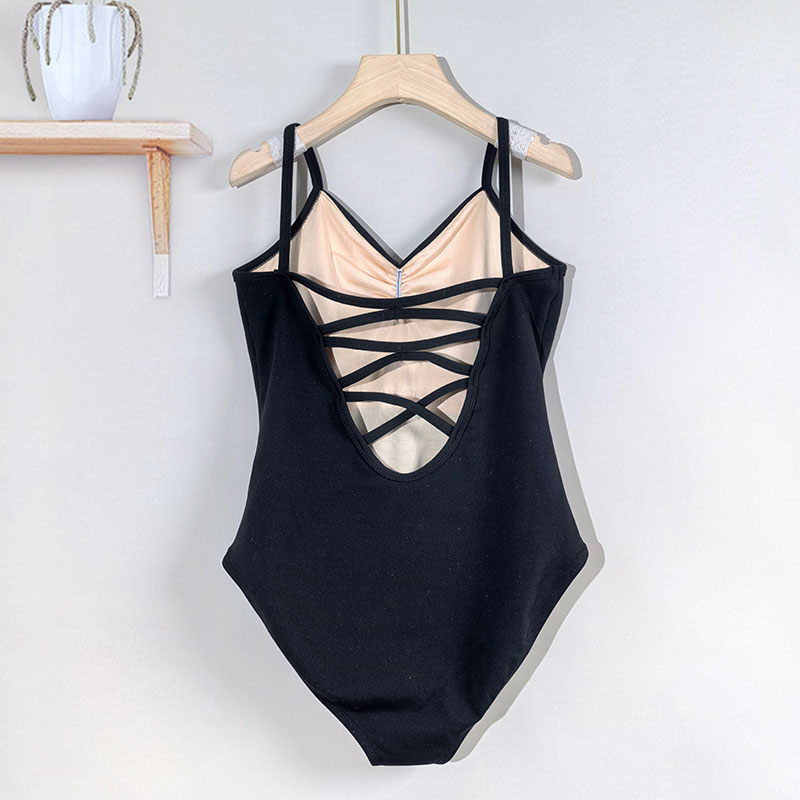
Jinwu Body danzatore a croce lists an adult XS–5XL range and a body fabric of 75% polyamide and 25% spandex. It is a camisole style with a ruched V-neck and open crossed straps. The listed size range identifies options to enquire about; it does not supply the body measurements behind every label.
Ask for the current chart and measurement diagram for that product. Do not borrow dimensions from another leotard simply because both list the same fibre percentages. Fibre composition alone does not establish the finished pattern, stretch behaviour or fit allowance.
Private-label buyers should also record which chart belongs to which approved version. If a pattern is revised or a different fabric is selected, ask the supplier whether the sizing guidance remains valid. A chart should follow the product it describes, not be copied unchanged because the labels look familiar.
Make the sample fitting answer a question
The chart narrows the choice; the sample tells you whether that choice works on the wearer. Before fitting, write down the uncertainty you are trying to resolve. It might concern body length, room through the hips or whether a neckline stays in place in ordinary movement.
Try the leotard with the permitted layers intended for use. Check that the wearer can move comfortably and is not repeatedly correcting straps, the neckline or the leg openings. Keep observations specific: a strap presses at the shoulder, excess fabric gathers at the waist, or the body feels restrictive when sitting.
Do not reduce every observation to “too small” or “too big.” A garment can fit adequately around the body and still be unsuitable in length. Record where the issue occurs, then ask whether the next sample should change size or construction.
A hanger photograph, such as the front and rear views used here, helps identify design details. It cannot establish how a size fits an individual. Keep that distinction clear when using product images beside a customer-facing chart.
Keep adult group orders traceable
For a studio or company order, distinguish the wearer’s measurements from the size requested and the size finally approved. Those are three different pieces of information. If a sample changes the selection, preserve the reason rather than overwriting the original measurement.
A simple ordering sheet can record a private wearer reference, product, measurement date, unit, key measurements, proposed size and fitting decision. Use only the information needed for the order and limit access appropriately. There is no need to circulate a named group’s body measurements to everyone in the class.
Count the final approved sizes after fitting decisions are complete. Check that every entry refers to the same adult chart version and product. This is particularly useful when several people collect measurements or a late addition joins an existing order.
What to send when the chart is incomplete
If the page lists sizes without dimensions, request the missing chart before allocating an order. Send the product reference and ask whether the table describes the body or the garment, which units it uses and how torso measurements are taken.
For a mixed-size case, include the relevant measurements and the chart row you are unsure about. For a custom development, separate the intended wearer measurements from any finished-garment specification. The supplier needs to know which is which.
Ask Jinwu for the adult measurement guidance for your selected leotard. Refer to the exact product rather than requesting an unspecified “standard size chart.” Confirm the sample size after the measurement method and any conflicting dimensions have been discussed.
conclusione
Read the chart’s definitions before reading its size labels. Match the measurement method, use consistent units and keep conflicting dimensions visible. The right next step is a sample chosen for the actual style, with a clear question for the fitting to answer.
FAQ
Can I use my usual dress size to choose a leotard?
Use it only as background information. Compare your measurements with the chart for the exact adult leotard, including the supplier’s torso guidance, before selecting a sample.
Does girth mean the same thing as waist?
Not necessarily. Leotard charts may use girth for a torso loop, while other measurement labels use girth to mean circumference at a specified body location. Follow the chart’s diagram.
Should I add extra room to every body measurement?
Not unless the supplier instructs you to. Report the measurements taken by its method. Adding an allowance yourself can distort the comparison with a chart that already accounts for intended fit.
Is adult XS equivalent to the largest child size?
Do not assume so. Compare the relevant adult and child measurements and ask about the cut. Similar labels or overlapping measurements do not make two garments interchangeable.
Can a retailer publish the factory’s flat garment table as a body chart?
No. Label finished-garment measurements accurately and obtain separate wearer guidance where needed. Renaming flat dimensions as body dimensions can lead customers to choose the wrong size.