
Elegir un leotardo de ballet de malla que se ajuste y cubra como se esperaba
Choose a mesh ballet leotard by looking at where the mesh sits, what is underneath it and how the seams behave in movement. A small shoulder insert and a large unlined upper bodice make very different garments, even when their floral patterns look similar. The right option should provide the coverage the wearer wants without restricting the movements the class requires.
For a school or retail collection, start with panel placement before comparing decorative finishes. It is easier to reject an unsuitable cut early than to discover during fitting that the preferred print leaves too much of the garment sheer or pulls across the shoulders.
Read a mesh ballet leotard as a panel layout
Identify the solid body fabric, mesh inserts, lining and openings in front and back views. Then ask whether each mesh area stands alone or lies over another fabric. An overlay can create texture over a covered area; an unlined insert creates a different degree of transparency.
The word mesh describes the fabric structure, not a complete material specification. Ask for its fiber composition and stretch information separately from those of the main body. Do not apply the body fabric’s percentages to every panel in the garment.
Jinwu Maillot de ballet floral de cuello alto illustrates that distinction. The product page lists a body fabric of 75% nylon and 25% spandex, alongside floral mesh described as 100% polyester. It also identifies an upper floral mesh design, a high neckline and elbow-length sleeves. Those details help define the style; they do not establish the mesh’s measured elasticity or the lining arrangement of every section.
Use a front-and-back sketch to mark any unresolved areas before ordering samples. A note such as “confirm whether the upper front is lined” is more useful than describing the whole garment as fully covered or sheer.
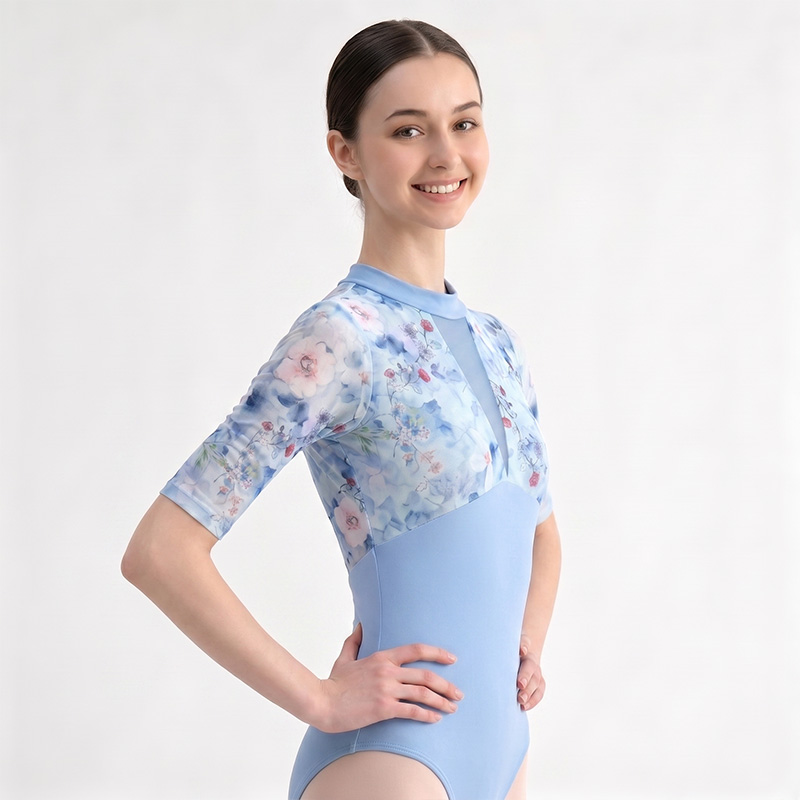
A high neckline does not guarantee opaque coverage
A high neck ballet leotard can cover more skin with fabric while still leaving that area visible through mesh. Separate the outline of the garment from its opacity. This is particularly important when a school asks for a particular level of coverage or a wearer plans to use an undergarment.
Check the sample under the lighting in which it will be worn. View it from the front, side and back, both at rest and during normal movement. A fabric that looks dense in a close-up photograph may appear more transparent when stretched over the body.
Decide where transparency is acceptable before choosing the floral pattern. If the wearer wants an opaque front, a decorative motif on unlined mesh is not a reliable substitute for an appropriate solid panel or lining. Ask for the relevant section to be shown from the inside as well as the outside.
Mesh at the back needs the same attention. Consider whether the panel reveals straps or layers the wearer expects to conceal. A beautiful back view on a product model does not establish compatibility with a different wearer’s preferred undergarment.
For school purchasing, have the teacher approve the exact sample. A style described as suitable for examinations or training on a product page still needs to meet the actual program’s rules.
The join between mesh and body fabric matters
The solid body and the mesh need to work together. If one section stretches readily while the adjacent section resists, the seam may become the point where the wearer feels restriction. Check the joined garment rather than comparing loose fabrics alone.
Look along curved upper-bodice seams, shoulder joins and armholes. The seam should sit as intended without persistent puckering, twisting or uncomfortable pressure during the fitting. If a problem appears only when the arms are raised, note that movement rather than describing the entire leotard as too small.
For a technical fabric comparison, the buyer and testing provider can agree a method such as ISO 20932-1:2018, with its applicable amendment, for elasticity and related properties. The test method and acceptance criteria must be specified. A fabric’s appearance, fiber percentage or “stretch mesh” description is not a test result.
Recovery deserves attention too. After the fitting movement, check whether the panel returns to its intended position or remains distorted. Keep observations tied to the sample and size examined. One well-fitting garment does not demonstrate identical behavior across a whole size range.
Where a seam is uncomfortable, ask the supplier to investigate the construction, fabric compatibility and fit together. Adding length or changing the label size may not address a poorly positioned or restrictive join.
Check sleeves with the arms moving
Mesh sleeves should be judged during movement, not only with the arms resting at the sides. Have the wearer raise and lower their arms, reach forward and bend the elbows through movements appropriate to their class. Notice whether the sleeve follows the arm or pulls the bodice upward.
For elbow-length sleeves, pay attention to the sleeve edge when the elbow bends. For shorter sleeves, examine the armhole and the point where the sleeve finishes. A comfortable sleeve opening in a static photograph may feel different during repeated movement.
Assess the high neckline at the same time. If it shifts or presses when the arms move, the cause may involve the sleeve, shoulder or torso fit rather than the neck opening alone. Describe where the pressure begins and which movement produces it.
Choose a smaller mesh area when the design only needs a subtle visual accent. Consider a larger upper panel when the wearer wants that appearance and the sample meets coverage and movement requirements. More mesh is not automatically a better training feature.
Printed mesh, flocked mesh and lace are not interchangeable
A floral appearance can come from different constructions and finishes. Print places a visual motif on a fabric surface; flocking adds a textured surface effect. Lace has its own patterned structure, although some products combine lace-like decoration with a mesh ground. Ask the supplier what the actual sample uses.
This distinction matters when translating a photograph into a purchasing brief. Requesting a lace ballet leotard because the image looks floral may produce a different material from a printed mesh reference. Name the finish and supply a close-up if the surface effect is central to the design.
| Design description | What to confirm | What the photograph cannot establish |
|---|---|---|
| Plain mesh insert | Panel position, mesh structure and lining | Actual transparency when worn |
| Printed floral mesh | Print reference, repeat and placement on each panel | Whether the approved motif placement will be repeated |
| Flocked mesh | Textured areas, backing and care instructions | How the finish feels and behaves after care |
| Lace or lace-effect panel | Whether it is lace, embroidery, print or another construction | Stretch, softness and seam comfort |
| Mesh overlay on solid fabric | Underlying material and how the layers are joined | Combined movement and finished coverage |
Jinwu Maillot de ballet de terciopelo flocado is a relevant textured example. Its published design includes a sheer mesh yoke and velvet flocking, with a nylon-and-spandex body and polyester mesh. This is a different surface treatment from simply printing a floral image onto mesh.
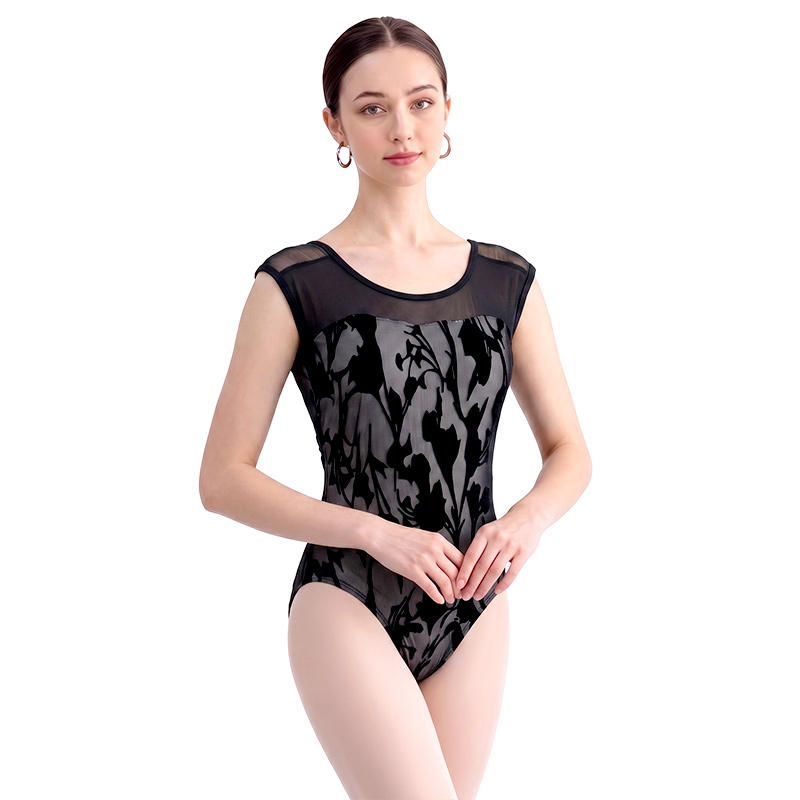
Compare these finishes on real samples. Do not promise that one is more durable, cooler or softer merely from its name. The useful comparison is whether the chosen construction delivers the appearance and wear experience required for the specific garment.
Decide on lining section by section
Specify ballet leotard lining where coverage is needed, then check how the added layer affects movement. Lining an entire mesh panel changes both its visual effect and the way the layers work together. A lining choice should be assessed as part of the finished sample.
Ask where the lining starts and ends. Its upper edge may be visible through the mesh, particularly when the wearer moves. If the intended effect is a continuous opaque area, check that the lining remains in the right position rather than stopping short of the area it is meant to cover.
A lining fabric also has its own color and composition. Compare it beneath the actual mesh rather than approving the two fabrics separately. A color that seems unobtrusive on the table can alter the appearance of a sheer panel when layered.
Lining is not evidence of built-in support. If the wearer needs support or intends to wear a separate garment underneath, confirm the construction and compatibility directly. The Guía para forro de leotardo y soporte incorporado explains that distinction in more detail.
Request the views and details that are missing
Ask for a clear front view, back view, close-up of the mesh and an inside view of the relevant lining and seams. Include an image of the whole garment so a detail photograph cannot be mistaken for a different style or revision.
Confirm the size chart for the exact product. Jinwu’s product pages can contain broad size descriptions alongside more specific category information, so obtain the current chart for the intended adult or child wearer before allocating sizes. Do not treat a general size-range claim as a completed fit check.
For a patterned panel, ask whether motif placement is controlled or allowed to vary. The answer affects how closely individual garments will resemble the photographed sample. Record any agreed placement requirement on the appropriate panel rather than assuming identical flowers will appear at every seam.
Give the supplier a concise brief: intended wearer, permitted sheer areas, sleeve and neckline preferences, lining coverage and the reference finish. Send those panel requirements to Jinwu with the product reference so the team can confirm a suitable sample or discuss a development request.
Review the sample as a complete garment
Bring the coverage, movement and appearance checks together in one fitting. A sample should not pass because the mesh pattern is attractive while an unresolved seam or lining issue is left for production to solve.
Record any changes against the sample revision. If the mesh, lining or panel shape changes, review the affected area again. A new mesh that looks similar can alter transparency or the behavior of the join, so a visual match alone is not enough.
Follow the proposed care instructions and inspect the sample afterward. Look for changes in panel shape, seam appearance and decorative finish. Do not invent a washing routine based solely on the body fabric; the mesh and surface treatment are part of the garment too.
Keep the approved reference with its material and construction notes. This gives the buyer and supplier something specific to compare against when the collection is produced or reordered.
idea de narración
A mesh ballet leotard should be chosen from its panel layout outward: coverage first, then movement, seam comfort and decorative finish. Clear product details and a finished sample reveal more than a floral photograph. Approve the exact combination of mesh, body fabric and lining that the wearer will receive.
preguntasrán el
Is every mesh panel stretchy?
No single stretch behavior follows from the word mesh. Ask for the specific material’s stretch information and assess it in the finished garment. The body fabric’s elasticity does not establish the properties of a separate mesh panel.
Does black mesh provide more coverage than a light color?
Color alone cannot establish coverage. Mesh structure, lining, tension and lighting all affect the finished appearance. Compare the intended colors on correctly fitted samples rather than judging from separate product photographs.
Can an unlined panel be lined later?
It may be possible, but the added layer changes construction and can affect fit or appearance. Ask the supplier to evaluate the alteration and provide a revised sample. Do not assume it is a simple change with no effect elsewhere.
Is a mesh style automatically cooler to wear?
The presence of mesh does not establish a measured cooling benefit. Panel area, underlying layers and the complete garment matter. Base any specific performance claim on relevant evidence for the actual construction.
Should the same mesh design be used for every size?
A consistent design can be the goal, but panel proportions and placement need review across the intended size range. Check that coverage and movement remain acceptable rather than approving every size from one sample photograph.