
लियोटार्ड के रंगों को रक्तस्राव से कैसे रोकें: देखभाल और गुणवत्ता की जांच
To reduce leotard color bleeding, follow the garment’s care instructions, keep an unfamiliar or suspect color away from pale items, and deal with wet garments promptly. If color continues to transfer under the recommended care conditions, stop experimenting and ask the supplier to investigate. A washing routine cannot guarantee that an unsuitable dyeing or finishing process will become reliable.
For a dancer, the immediate concern may be stained tights. For a school or retailer, the same complaint raises a wider question: is this an isolated handling incident, a problem with one colorway, or an issue that needs checking across an order? The answer starts with separating what happened from what you assume caused it.
First, Identify What Has Actually Changed
“The color ran” can describe several different observations. A tinted wash basin, a mark on tights and a faded patch on the leotard do not necessarily have the same explanation. Record where the change appeared and whether it followed washing, wear or storage.
| Observation | Possible explanation | Useful next check |
|---|---|---|
| Color appears in wash water | Dye has been released during washing | Note the method, products and garments in the wash |
| A colored mark appears where two surfaces rubbed | Color transfer through friction, often called crocking | Record the contact area and whether it was wet or dry |
| A light panel has picked up another color | Transfer from a neighboring panel or another item | Identify what touched it during wear, washing and drying |
| The original shade looks lighter without a separate stain | Fading or another surface change | Compare with an unworn reference under the same lighting |
Iowa State University Extension distinguishes bleeding from crocking: bleeding involves dye released into a liquid, while crocking is transfer caused by rubbing. Neither term, on its own, proves which production or care step was responsible.
Photograph the whole garment as well as the affected area. A close-up can hide whether a mark follows a seam, a folded edge or a point of contact with another garment. Describe the observation plainly before naming a defect.
Read the Label Before Changing the Wash
Start with the instructions supplied for that finished leotard. The body fabric is only part of the garment; mesh, lining, elastic and decoration may change what treatment is suitable. A routine used for a plain practice leotard should not automatically be applied to a decorated dress.
If the label says to wash separately, take that instruction literally. For other items, the American Cleaning Institute’s laundry guidance recommends sorting by color, fabric type and washing instructions. Do not put an unfamiliar dark leotard into a pale load simply because both garments are dancewear.
Check the permitted washing method, temperature, detergent guidance and drying method together. “Cold wash” does not answer whether soaking, machine washing or a particular treatment product is allowed. If instructions are incomplete or appear to conflict, ask the supplier to clarify them before treating a new garment.
For school purchasing, keep the confirmed instructions with the exact style and colorway. A generic handout is easy to distribute, but it becomes unhelpful if it covers products with different care requirements. Make sure families receive the instructions that belong to the garment they were issued.
One Leotard Can Contain Several Different Color Risks
Washing a garment alone separates it from other clothing. It does not separate a dark body panel from a pale insert sewn into the same garment. Buyers of color-block, printed or mesh-panel designs therefore need information about the finished combination, not just the main fabric.
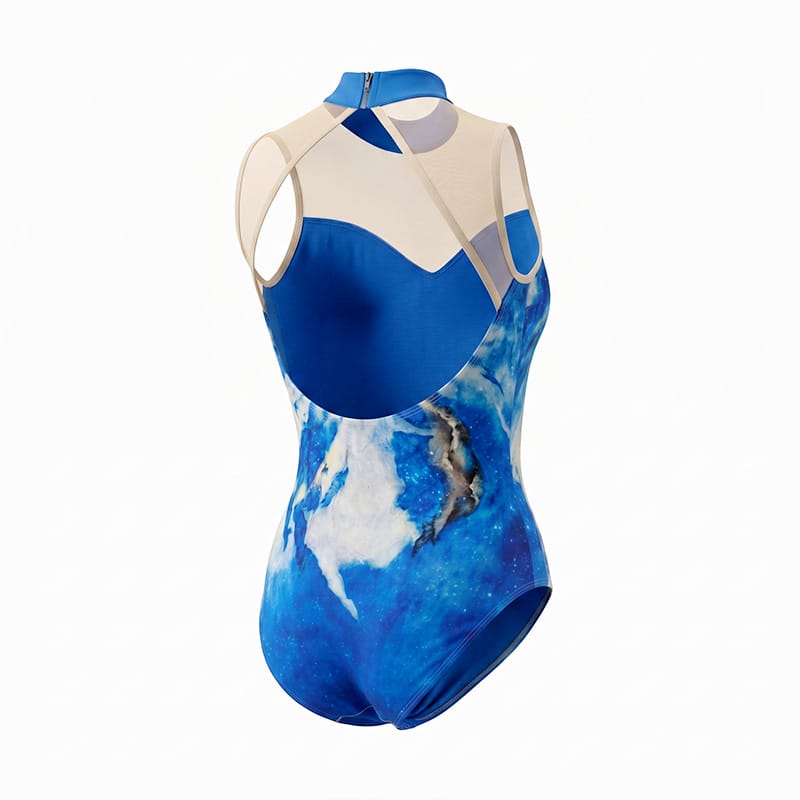
Jinwu's मार्बल प्रिंट बैले लियोटार्ड provides a useful example of a design with visibly different areas: a patterned body and a sheer upper section. These photographs show the intended construction and appearance; they do not show damage or establish a colorfastness result.
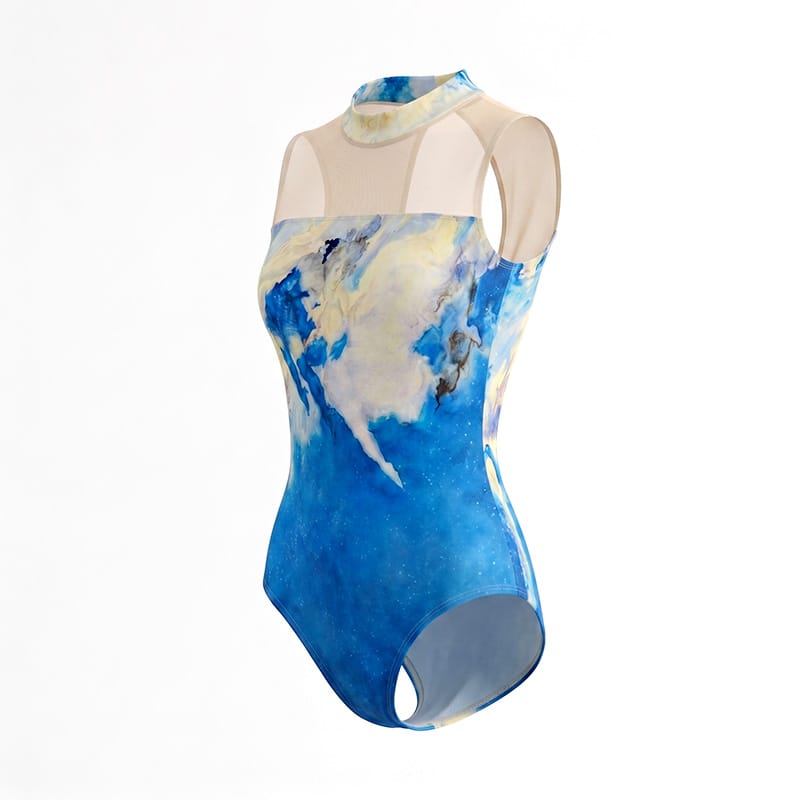
When discussing a similar design, identify every contrasting area that matters: body, upper panel, binding, straps, lining and attached skirt if present. Ask which materials and colors were included in the care review. A result for the body fabric alone does not tell you how a neighboring pale panel will look after the garment is cared for.
Do not assume that a pale color is automatically trouble-free or that a dark color will necessarily bleed. Keep the enquiry specific to the material, colorway and production reference. The visible shade is a reason to ask the right questions, not a substitute for evidence.
Pay Attention to the Time Between Wearing and Drying
Color transfer is not confined to the washing machine. Look at the ordinary journey from studio to home: a leotard may be pressed against tights, wrapped inside another garment or left in a bag after class. If a mark appears before washing, those contacts belong in the investigation.
After a permitted wash, remove the garment promptly and dry it using the specified method. Iowa State’s guidance notes that wet items left together are more likely to transfer color. Avoid leaving a suspect leotard bundled against light clothing while deciding what to do.
A school can make this practical without inventing a universal drying rule: ask families to follow the garment instructions and avoid leaving used clothing mixed together in a bag. If a supplier specifies a particular drying arrangement, communicate it accurately rather than replacing it with a familiar routine.
For recurring incidents, record when the garment was packed, washed and dried. The purpose is to identify conditions that might matter, not to assume the wearer caused the problem.
Salt and Vinegar Are Not a Reliable Fix
Iowa State University Extension specifically rejects the claim that a salt or vinegar wash reliably fixes dye in a finished garment. A treatment seeming to help once is not proof that it has made the color stable.
Do not turn that uncertainty into a series of stronger home treatments. A leotard may combine several materials, and a remedy intended for one textile is not automatically suitable for the complete garment. Obtain instructions that cover the actual product before adding a dye fixative, color remover or other treatment.
The same caution applies to treating an entire school order after one complaint. An improvised process can change the garments and make the original issue harder to assess. First establish what happened, what the care instructions permitted and what the supplier recommends for the affected style.
Color-catching laundry sheets are not a substitute for sorting or garment instructions. If you use an additional laundry product, check its directions and compatibility rather than treating its presence as permission to mix an unverified color with pale pieces.
If Color Has Already Transferred, Preserve the Evidence
Separate the suspected source from the affected items and photograph both before further treatment. Note whether the stain was visible while wet, after drying or only when the garments were next worn. Keep the care label available and record what has already been tried.
There is no single stain-removal recipe appropriate for every leotard. The American Cleaning Institute’s laundering problem guide distinguishes dye transfer from other causes of discoloration and makes treatment dependent on fabric suitability. Advice that permits bleach or a higher temperature for one textile is not permission to use it on your garment.
Ask the supplier for a treatment recommendation that covers the affected fabric, trims and decoration. If a procedure would conflict with the care label, resolve that conflict first. Keep a written record of the recommendation so a school, retailer or customer-service team can give consistent guidance.
A photograph cannot establish whether a stain is reversible. Avoid promising a customer that another wash will remove it, and avoid repeatedly treating the same area while waiting for a response. A clear account of the original condition is more useful than a garment that has undergone several undocumented experiments.
Ask Which Kind of Colorfastness Was Evaluated
Colorfastness is a description of resistance under specified conditions, not one universal property. The American Association of Textile Chemists and Colorists’ colorfastness training covers separate evaluations for laundering, rubbing, perspiration, water and light. Evidence for one exposure does not settle all the others.
उदाहरण के लिए, आईएसओ 105-X12:2016 addresses colorfastness to rubbing, including dry and wet rubbing. It is relevant to a concern about contact transfer; it is not a wash-care instruction or proof that a complete leotard has passed a laundering assessment.
For a purchase decision, request the material or garment reference, tested color, method and version, conditions, results and date. Ask how that reference relates to the proposed order. A report for another color or an earlier material can provide context, but the relationship needs explaining.
Agree the evaluation and acceptance requirements with the supplier or testing provider before treating a result as a pass. This article does not assign a universal grade to all dancewear, and no laboratory result is claimed for the photographed Jinwu product.
Give the Supplier a Case It Can Investigate
A useful report connects the observation to a particular garment and order. Include the style, color, size, order reference and any batch identifier available. Describe the affected area and identify other items that were worn or washed with it.
Add the washing method, temperature setting, detergent or treatment used, drying method and whether the issue appeared on the first use or later. Send clear photographs of the label and the whole garment alongside the close-up. Say what is known and leave unknown details marked as unknown.
For multiple complaints, keep separate records rather than combining them into “all colors bleed.” Compare whether they concern the same style, color or delivery. A pattern may justify a broader review, while unrelated incidents may need different explanations.
Before reordering, ask what has been established and whether the material, process, care instructions or proposed checks have changed. Send Jinwu the affected style and color-transfer details to discuss the relevant product information and next steps. A documented explanation is more useful than an unsupported assurance that the next order will be fine.
निष्कर्ष
The practical answer to how to stop leotard colors from bleeding is to combine appropriate care with a clear response when transfer occurs. Follow the garment instructions, separate suspect colors, record the circumstances and seek evidence relevant to the actual material and exposure. Persistent transfer needs investigation, not a stronger laundry guess.
अक्सर पूछे जाने वाले प्रश्न
Does colored wash water mean the leotard is ruined?
Not by itself. It shows that color entered the water, but you still need to inspect the garment and any adjacent materials. Record the observation and follow the supplier’s guidance rather than assuming either permanent damage or complete harmlessness.
Can a leotard pass a rubbing test and still have a washing problem?
Yes. Rubbing and laundering expose materials to different conditions. Ask for evidence that addresses the reported problem instead of treating one colorfastness result as a guarantee for every form of use.
Is machine washing always the cause of bleeding?
No. The permitted washing method depends on the garment, and color transfer can also occur through contact or other wet handling. Compare what happened with the actual instructions before assigning a cause.
Should I test every garment in a new delivery at home?
Do not turn an informal check into an unplanned treatment of the whole order. Agree a review approach with the supplier, identify the relevant styles and colors, and retain an unchanged reference where practical. A home observation is not a laboratory result.
Can I publish a claim that a leotard will never bleed?
Avoid an absolute claim. Describe supported product information and supply the appropriate care instructions. Any performance claim should match the material or garment evaluated and the conditions covered by the evidence.