
Choisir un justaucorps d'audition de ballet : Lisez le mémoire, puis vérifiez l'ajustement
The best ballet audition leotard is one that meets the organiser’s instructions and feels familiar during movement. Check the required colour and style, confirm whether skirts or decorative panels are permitted, then try the complete outfit in class before the audition. A new design is useful only if it solves a real requirement.
There is no single black-leotard rule covering every school, programme or audition format. Equally, permission to wear a solid colour does not automatically answer questions about mesh, an attached skirt or an open back. Treat the invitation and current official guidance as the starting point.
Turn the audition brief into a clothing decision
Find the instructions for the exact programme, applicant group and audition stage. Requirements for an in-person class may differ from those for application photographs or a recorded variation. Save the relevant page or message with the audition details so you can check it again before travelling.
The Royal Ballet School’s in-person audition guidance, checked in September 2026, advises applicants to wear comfortable, familiar dance-school clothing and says special new clothing is unnecessary. This is useful reassurance for its applicants, not permission to disregard a different organiser’s instructions.
If you are uncertain about a feature, ask a narrow question with the product photograph attached. “Is this back design permitted?” is easier to answer than “What should I buy?” Give the programme and audition date so the reply applies to the correct event.
| Instruction or uncertainty | Decision it affects | Quoi vérifier |
|---|---|---|
| A specified leotard colour | Which colours remain on your shortlist | The exact wording and any supplied colour reference. |
| A plain or solid-colour requirement | Print, contrast panels and decoration | Whether the proposed fabric and construction meet that requirement. |
| No skirt or frills | Attached skirts and removable layers | Whether the base leotard can be worn alone. |
| Different video and in-person instructions | Whether one outfit serves both stages | The instructions for each submitted section or appearance. |
| A support or coverage concern | Neckline, back opening and underlayers | The dancer’s needs and any relevant restrictions. |
| No clear instruction on a detail | Avoiding an unsupported assumption | A direct reply from the organiser before purchase. |
Keep the brief separate from marketing language. A catalogue may describe a leotard as suitable for auditions, but only the audition organiser can establish whether it meets that event’s dress code.
Choose colour within the rules
Black is an option when the brief permits it, not an automatic requirement. The School of American Ballet’s January 2026 summer-audition guidance, for example, specified a solid-colour leotard for its Girls Training Track rather than requiring black. Applicants should still check the information for their own audition cycle.
Where several colours are allowed, choose one the dancer is comfortable wearing and assess it with the rest of the outfit. Do not choose a colour solely because someone claims it will attract a panel’s attention. Clothing cannot guarantee a favourable result.
Check the actual garment rather than relying entirely on a screen image. Lighting and display settings can affect the appearance of a colour, so a school purchasing several leotards should agree a physical reference where consistent matching matters.
If the brief names a precise colour, avoid treating a close-looking shade as automatically equivalent. Ask the organiser when the distinction matters. A retailer can help by showing the available colour clearly without declaring that it satisfies every school’s use of the same colour name.
Read the whole design, including the back
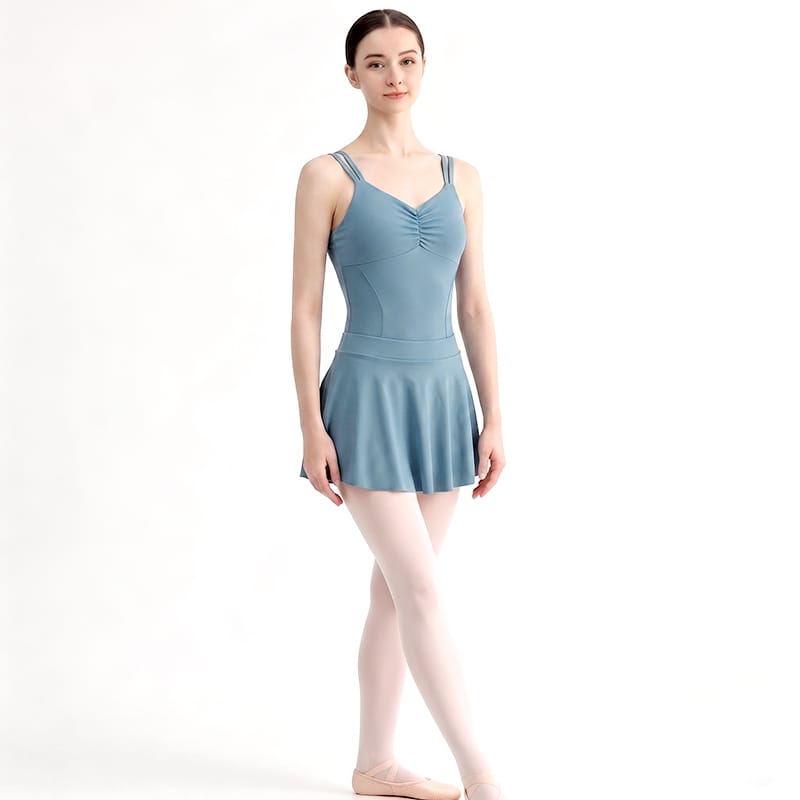
Start with the features that can change compliance: attached skirt, pattern, sheer areas, decoration and unusual openings. Then consider the dancer’s preferred coverage and support arrangement. Look at front, side and back views before deciding from a thumbnail.
Jinwu Tenue de démarrage de ballet is described as a camisole leotard with a gathered front and a matching pull-on skirt. A separate skirt is relevant when an applicant needs to wear the leotard alone. Confirm the actual set contents and construction; the product name itself does not establish audition approval.
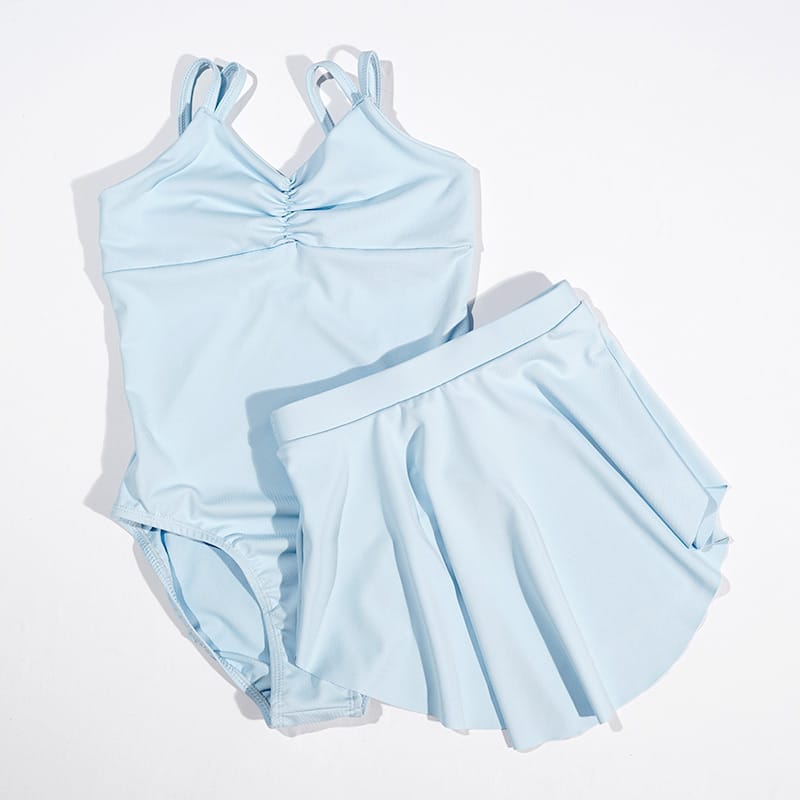
When a brief excludes a skirt, assess the leotard without it. Check the leg line and the coverage the wearer wants rather than assuming the skirt can remain as a comfort layer. If the resulting outfit does not work for the dancer, discuss an acceptable alternative early.
A decorative back is another decision that deserves a direct look. It may affect underlayer compatibility even where the organiser allows the design. A front view alone will not show whether the dancer’s preferred bra or support garment remains covered.
Use a familiar fit check
Try the candidate leotard during normal, appropriate class movement before relying on it for an audition. Check whether the straps remain in place, whether the neckline maintains the desired coverage and whether the leg openings stay comfortable. The dancer should not need to think continuously about adjusting the garment.
Ask for feedback in specific terms. “The shoulder strap moves when I raise my arm” or “the neckline gaps when I bend” gives a useful next step. A vague impression that the garment needs to be tighter can lead to a different problem without resolving the first.
Use the chart for the exact style when comparing sizes. Body length and circumference may need separate consideration, especially if one size feels short but the next is loose. The guide to leotard proportions and coverage explains how to describe a mismatch between measurements without relying on size labels alone.
Do not make an audition the first wear of an unfamiliar cut. If a new garment is necessary, leave time to try it, confirm its care instructions and assess it again after any permitted preparation. A previous favourite that still fits and meets the brief may already be the right choice.
Check the full outfit together
Put on the intended tights, shoes and underlayers with the leotard. Look at the outfit in motion rather than evaluating each piece separately. A neckline that works with one support arrangement may not work with another, and changing the waistband position of tights can change how the wearer experiences the leotard.
Follow the organiser’s shoe and tights instructions. Do not transfer a requirement from a different age group or stage of training. If pointe shoes are mentioned, discuss the requirement with the dancer’s teacher and the organiser; buying them does not establish readiness to use them.
Check hair arrangements with the garment as well. A closure at the upper back should be manageable without undoing the hairstyle. For a younger applicant, practise with the caregiver who will actually help on the day.
Identify which layers belong in the waiting area and which may be worn during the audition itself. A warm-up layer can be useful before class while still being excluded from the audition outfit. Keep the underlying leotard ready rather than discovering a problem only when the layer is removed.
Make a short camera check for video auditions
For a recorded audition, follow the programme’s framing, clothing and exercise instructions first. Then record a brief test in the intended location before filming the full submission. Review whether the dancer remains visible and whether the outfit’s outline is clear against the background.
Check the beginning and end of movements, not just a still frame. A garment may look comfortable while standing but need adjustment during a reach or bend. A short test also reveals whether the chosen camera angle hides part of the body or whether a background object interrupts the view.
If the permitted colour is difficult to distinguish from the background, adjust the setting or lighting within the audition guidance before replacing an otherwise suitable leotard. Do not digitally alter the garment or the dancer’s shape to solve a presentation issue.
Keep this check practical. Its purpose is to make the required performance visible, not to produce a fashion film. Ask the regular teacher for help interpreting the audition requirements where needed.
Prepare without last-minute experiments
Set aside the complete approved outfit before the audition day. Check seams, straps, fastenings and the condition of the tights and shoes. Use the garment’s care instructions rather than a new treatment intended to make it look different at the last moment.
Pack a suitable spare only where useful and available, and make sure it also meets the brief. A spare with a prohibited skirt or an untested fit is not an equivalent replacement. Keep small required items identifiable so the dancer is not searching through an unfamiliar bag.
Save the clothing instructions where the accompanying adult can access them. If there has been a direct clarification from the organiser, keep that message too. This is particularly helpful when a teacher helped choose the outfit but a parent is taking the dancer to the venue.
Once the garment has passed the relevant checks, leave it alone. Changing straps, adding trim or trying a new underlayer immediately before the audition introduces a decision that has not had the same preparation.
How schools and retailers can help
A useful audition-wear selection should explain garment features rather than claim to know what every panel prefers. Show skirt attachment, front and back coverage, lining information and the style-specific size chart. Make exclusions and optional pieces clear.
For schools preparing recommendations, link to the organiser’s current instructions alongside any suggested product. State the programme or event to which the recommendation applies, and review it when the audition cycle changes. Avoid allowing last year’s checklist to become an unofficial rule for all applicants.
Pour une demande de Jinwu, send the audition dress requirements and the product reference, then ask about the relevant construction, colour and measurement details. The supplier can clarify the garment; the organiser remains the source for dress-code approval.
conclusion
Choose the leotard from the audition requirements, then confirm comfort and coverage in the complete outfit. Familiarity, clear instructions and a useful fitting matter more than finding a special “audition” design. Finish those decisions early so the dancer can focus on the class.
FAQ
Does my audition leotard have to be black?
Only if the organiser requires black. Some programmes allow other solid colours. Check the instructions for the exact audition rather than treating a common choice as a universal rule.
Do I need to buy a new leotard?
Not when an existing garment fits comfortably, is in suitable condition and meets the brief. New clothing is not an audition requirement unless the organiser specifies something your current outfit lacks.
Can I wear a mesh leotard if the brief says plain?
Ask the organiser about the specific design. A single-colour garment may still have sheer panels or decorative construction that the brief does not permit.
Can the same outfit serve a video and an in-person audition?
Possibly, but compare both sets of requirements. Photograph, video and class instructions can differ, even within one application process.
Does a product described as audition wear have school approval?
No. That description identifies an intended use. It does not establish endorsement by a school or compliance with an individual audition’s requirements.