
Etiquetas personalizadas de ropa de baile: qué aprobar más allá del logotipo
Custom dancewear labels need to do more than carry a brand name. They should help the wearer identify the size, find the relevant product and care information, and use the garment comfortably. Before approving production, review the wording, label construction and position on an actual sample—not just an enlarged artwork file.
For a close-fitting leotard, a label is part of the garment the dancer feels. For a retailer, it is also information that must remain consistent with the product page, packaging and order records. Treat those requirements as one development task while keeping their purposes distinct.
A Brand Label and a Care Label Have Different Jobs
A brand label identifies the collection or business. A size label identifies the garment’s place in the range. Fibre, origin and care information answer different questions. Some information may share a label, but combining it does not make any of those functions disappear.
A hangtag can carry a story, product reference or retail information. It should not be assumed to replace information that needs to remain with the garment. Decide which content belongs on the product and which belongs on removable packaging before the design team begins arranging the logo.
Jinwu Información de servicio OEM y ODM lists labels and packaging among the available customisation areas. Use that as the starting point for a project enquiry, then confirm which label formats, attachment methods and locations are suitable for the chosen garment. The public service description does not establish every possible label technique.
If the brief simply says “add our label,” expand it. Name the information to be supplied, the intended market, the garment styles involved and who will approve the final wording. That prevents a brand artwork approval from being mistaken for approval of all product information.
Choose the Format Around the Finished Garment
A sewn-in label, a printed label and a direct print on the garment present different questions. Discuss the options the manufacturer can actually supply, then compare them on legibility, attachment, wearer contact and compatibility with the fabric. Avoid choosing from appearance alone.
| Format under consideration | Useful reason to consider it | What the sample needs to establish |
|---|---|---|
| Sewn-in woven or printed label | A separate, clearly defined label component | Edge feel, fold, attachment and visibility through the garment |
| Direct print or transfer, if available | No separate loose label edge at that location | Readability, surface feel and suitability for the actual fabric and care method |
| Combined brand and information label | Related information kept in one place | Access to all text without overcrowding or hiding a required part |
| Hangtag or packaging insert | Room for removable retail information | Consistency with the permanent product information |
Do not call a direct print “comfortable” merely because it has no sewn edge. Its surface still needs checking against the skin, and its application needs to suit the material. Equally, a separate label should be assessed in its finished fold and attachment, not dismissed from a photograph of the loose component.
Ask the supplier to identify the proposed format in the sample record. If the technique changes later, review the result again. An artwork file can remain identical while the label’s physical behaviour changes.
Specify the Location with a Reference Point
“Inside the back” is often too vague for a dancewear brief. A leotard may have a high back, a low opening, crossed straps or a sheer panel. The same instruction can place the label somewhere quite different on each style.
Use a garment drawing or a marked photograph to show the intended location. State which seam or construction feature provides the reference, which way the text faces and how the label is attached. If a placement dimension is required, agree its measurement points and units rather than leaving the factory to interpret a visual estimate.
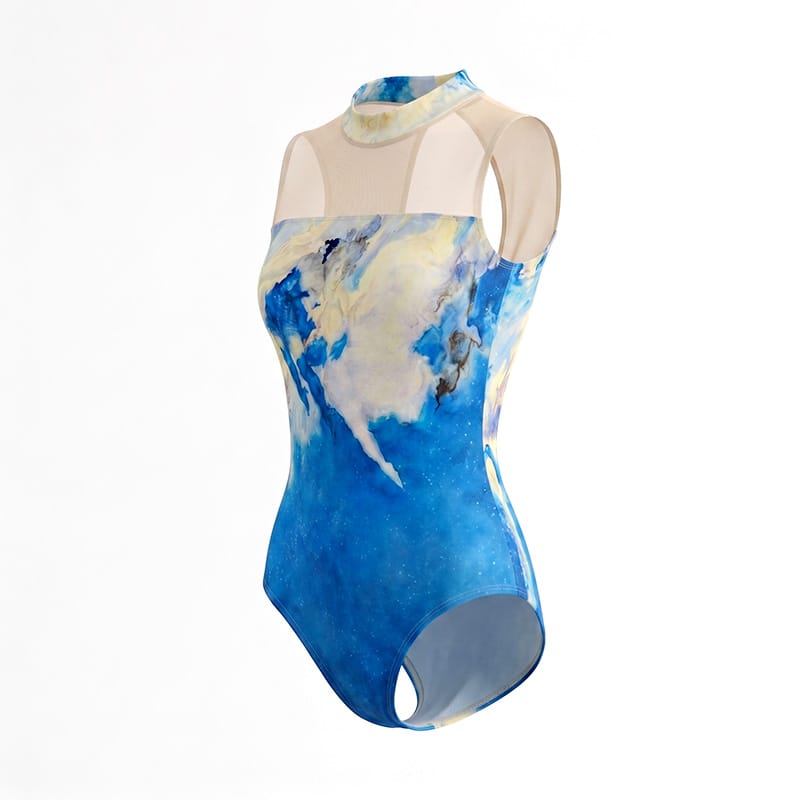
Jinwu Maillot de ballet con estampado de mármol has a sheer upper section and a shaped back opening. That construction illustrates why the label location should be considered on the actual style. The photographs here show garment features to discuss, not an approved custom-label placement.
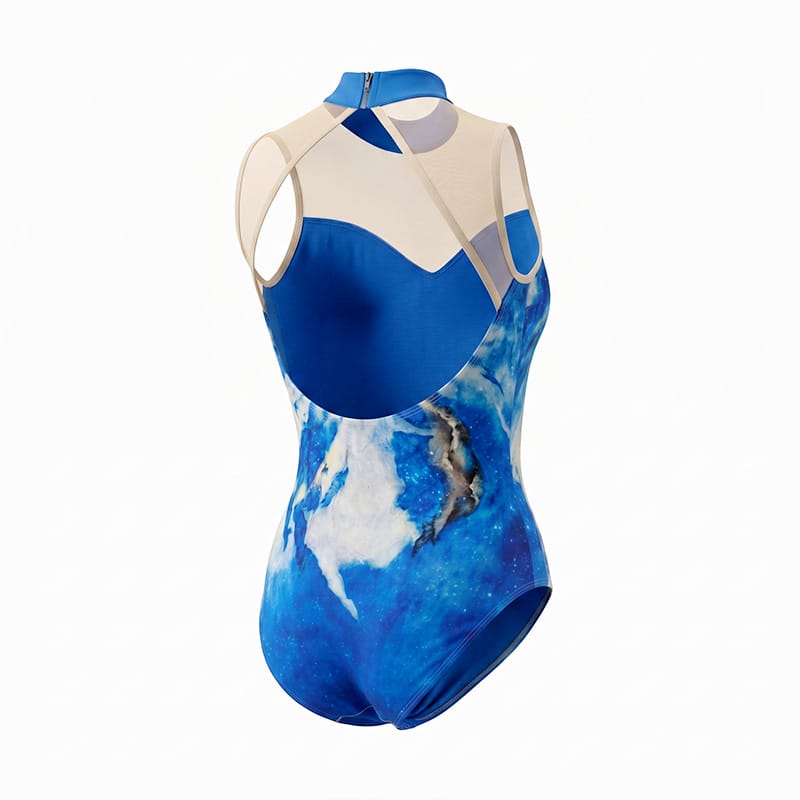
Check whether the label can be seen through the outer fabric or interrupts a feature intended to remain clear. Also check whether the wearer can find and read the information. A hidden location is not necessarily a useful one.
Confirm the Information Before Building the Artwork
Prepare a content sheet before arranging text around the logo. Identify the exact style, material composition, size naming, origin information and responsible business details that apply. Mark any information awaiting confirmation rather than filling the space with a generic example.
The destination market matters. For the United States, the Federal Trade Commission’s textile labelling guide explains the requirements for most covered textile products, including fibre content, country of origin and the identity of the responsible manufacturer or marketer. This is a US reference, not a universal label template for every country.
Use verified material information for the exact garment. A fibre description copied from another style can be wrong even if the photographs look similar. If the garment includes different components, establish how their information should be presented for the relevant product and market.
Keep size naming consistent with the approved range. A label marked medium should agree with the product page and the order record for that style. Changing the label does not change the fit, and a familiar market name should not be substituted without checking what the underlying size actually represents.
Care Wording Must Match the Complete Product
A care label is not a place for a standard instruction pasted across every collection. Body fabric, lining, mesh, decoration and attachment methods can all matter. Confirm the instructions for the finished garment and retain the basis for them.
los FTC’s Care Labeling Rule guidance says covered US manufacturers and importers need reliable support for their care instructions, including the garment as a whole. It also addresses permanent attachment and legibility. A successful check of one component is not enough if the completed combination is harmed by the recommended care.
For a leotard-and-skirt set, establish whether the pieces have the same instructions and whether they may be sold separately. Keep each piece traceable in the label plan. Do not assume that information on a bag will remain available after the customer separates the garments.
If the care recommendation changes during development, update the artwork before approval. Then check that the product page and customer handout use the same instructions. Conflicting information can leave the wearer unable to tell which version applies.
Review the Artwork at the Size It Will Be Used
An enlarged screen proof makes small text look easy to read. Review the proposed label at its actual finished dimensions as well. Include folds, attachment areas and any text printed on the reverse, so the proof represents what the customer will encounter.
Check spelling, punctuation, size designation and the exact material wording against the approved content sheet. Examine the logo separately for correct proportions and version. A familiar logo can attract attention while a small but important text error goes unnoticed.
If the label has multiple languages, review each version rather than assuming that a supplied translation preserves the meaning. Confirm which language versions are required for the intended market and which are optional. Do not compress the layout until the smallest text becomes impractical to read.
Give the artwork a clear revision identifier. Comments such as “use the latest file” become unreliable when several people send attachments. One named final file should be the reference for the next physical sample.
Check the Label While the Garment Is Worn
A loose label can demonstrate colour and text, but only an attached sample shows placement, edge feel and the relationship with the garment. Ask for the proposed label on the actual style before treating the development as finished.
During the fit review, ask the wearer whether the label is noticeable at the agreed location. Look for a fold or edge that sits awkwardly, an attachment that distorts the fabric, or information that is difficult to access. Describe the observation without assuming the same result will apply to every label format.
Review the garment from the outside too. A label behind a pale or sheer section may be visible in a way that the artwork proof did not reveal. Check the relevant sizes if a change in garment proportions could alter its position.
After the agreed care review, inspect the text, attachment and surrounding material again. Record what was checked and under which instructions. This is a product-development observation; do not turn it into an unsupported claim about lifetime durability.
Keep Label Approval Separate from Garment Approval
Use a short approval record that names the style, label content revision, artwork revision, finished dimensions, location and attachment method. Include photographs of the accepted sample. List any exceptions instead of relying on a general “looks good” message.
A garment can be approved for fit while its label remains unfinished. A label can be approved for artwork while its attachment still needs review. Name those decisions separately so neither team assumes that one approval covers the other.
Link the label record to the garment’s technical documentation. If a fabric, size system, market or care instruction changes, the label should be part of the revision check. Reusing an old artwork file without that check can carry obsolete information into a new order.
For a Jinwu label enquiry, send the garment style, destination market and approved brand artwork, together with the information that must appear and any preferred location. Ask which formats are feasible and what sample will be supplied for confirmation. This makes the request more useful than sending a logo alone.
idea de narración
Custom dancewear labels work best when content, construction and placement are developed together. Confirm the product information, review artwork at actual size and check the attached label on the finished garment. Keep those approvals traceable so the branding and practical information remain aligned from the first order to the next.
preguntasrán el
Can I add my own label to an existing Jinwu style?
Jinwu publicly lists label customisation among its services. Confirm the chosen style, proposed format and attachment with the supplier; availability of label support does not confirm every technique or placement.
Is a brand label enough for a private-label leotard?
A brand label identifies the business or collection. Product and care information have separate purposes and may be subject to destination-market requirements. Develop the full content plan rather than treating the logo as the complete label.
Can the same label artwork be used on every size?
Some content may remain the same, while the size designation changes. Check that the label still fits the intended location and remains usable across the garment range before applying one physical format to all sizes.
Should I remove a care label to make a sample more comfortable?
For development, report the discomfort and ask for an alternative compliant placement or construction. Removing information from the sample does not solve how the finished product will provide that information to the wearer.
Can a hangtag carry extra product information?
Yes, it can provide useful removable information, such as a style reference or brand story. Keep it consistent with the garment and do not assume it replaces information that must remain attached under the applicable requirements.