
كيفية اختيار صانع ملابس رقص يمكنك العمل معها
Choose a dancewear manufacturer by checking how well the supplier understands your product, how clearly it explains production responsibilities, and whether it can turn an approved sample into a repeatable order. A broad catalogue is a starting point. The more useful evidence is a relevant garment, a documented development process and a precise response when something needs changing.
For a ballet school, the deciding issue may be keeping the same uniform available between intakes. For a brand developing a new leotard, it may be pattern development and fit across sizes. Both buyers need reliable production, but they should not make their decision from the same shortlist of features.
Start with the Work You Need the Manufacturer to Do
Before searching for a dancewear supplier, describe the starting point. Do you already have a finished specification and a fit standard, or do you need help deciding the shape, materials and construction? A supplier that can reproduce a settled design may not offer the development support your team needs.
Prepare a short brief covering the garment, wearer, intended use, size range, colours, approximate quantities and required arrival date. Include the destination market and any school or performance requirements. Separate decisions already made from questions you want the manufacturer to help resolve. This gives the supplier a fair opportunity to identify missing information.
For example, an illustrative school brief might ask for a repeatable navy camisole uniform with a specified neckline and separate skirt. A retail brief might ask for a distinctive cross-back style with a new colour combination. The first project depends heavily on continuity; the second asks more of development and approval. Neither description is detailed enough to release production, but each makes the initial conversation useful.
If the project route is unclear, our دليل OEM مقابل ODM Dancewear explains how the starting design and development responsibilities affect that choice. Settle those responsibilities before comparing suppliers as though they are offering identical work.
A Relevant Portfolio Matters More Than a Large One
Look for experience with the construction you intend to order. A plain tank leotard, a garment with sheer panels and an attached-skirt dress create different questions. Ask to see the inside as well as the outside: seam positions, lining edges, strap attachment and the junction between contrasting materials can be more informative than another styled photograph.
A ballet leotard manufacturer should be able to discuss where the garment needs to stretch, where it needs to remain secure and how the proposed construction will be reviewed. Listen for questions about torso fit, neckline coverage and the intended wearer. General statements about softness or quality do not establish suitability for your design.
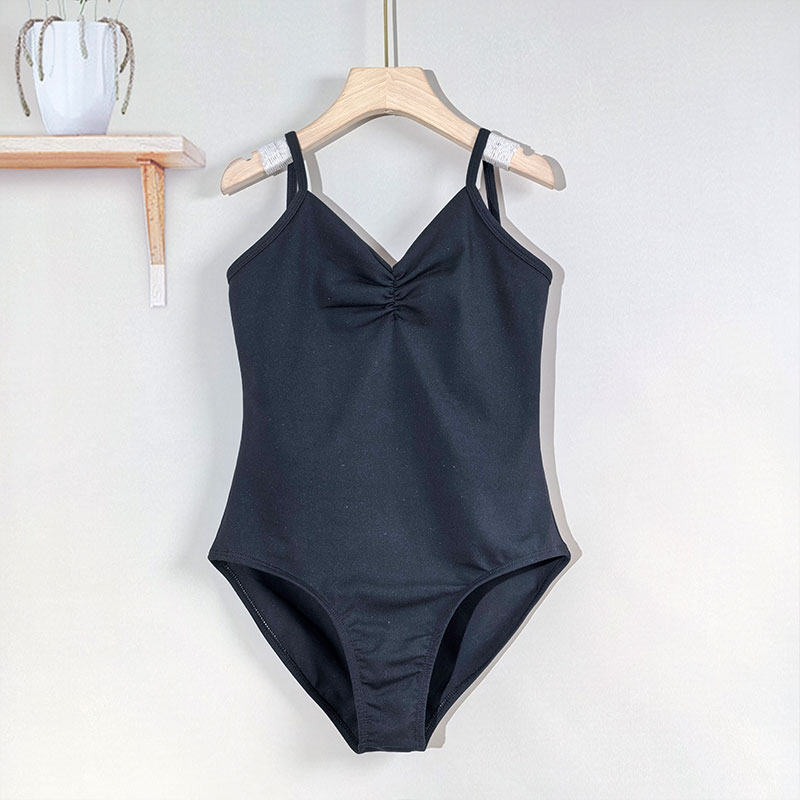
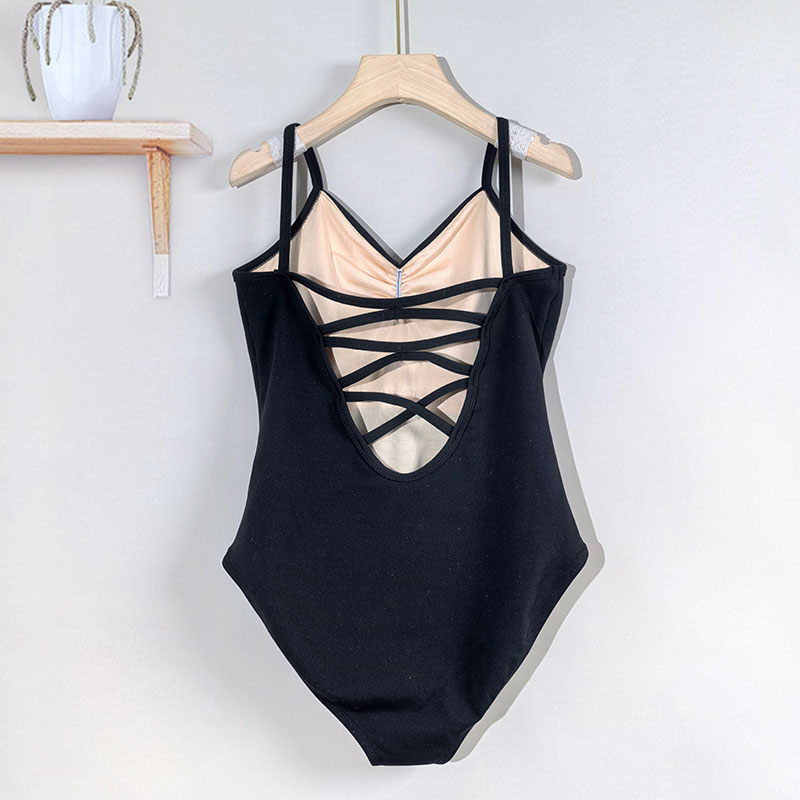
Jinwu ثياب الباليه المتقاطعة, for example, is listed with a polyamide-and-spandex body and crossed back straps. Those concrete features give a buyer something to discuss: how the straps meet the body, how the back opening behaves during movement, and which elements could remain unchanged in a proposed adaptation. The listing alone does not confirm that every requested alteration is available.
Ask whether portfolio items were developed, manufactured or simply supplied by the business. These are different contributions. A supplier may legitimately have experience in more than one role; what matters is understanding which role applies to your order.
Find Out Who Actually Makes the Garments
The word “factory” is not enough to establish the production arrangement. Ask which business will accept the order, where cutting and sewing take place, and whether printing, embroidery or other processes are handled elsewhere. Then ask who manages inspections and approves corrections across those locations.
A direct manufacturer may provide close access to its production team. A sourcing or trading business may coordinate several specialists. Neither arrangement automatically establishes the quality of the finished leotard. Prefer the arrangement in which responsibilities are visible and someone can resolve a production question without passing it indefinitely between parties.
Useful corroboration can include company details that match the order documents, a current view of the relevant production area and a discussion with the person responsible for your garment. Treat a video call as one piece of evidence, not a factory audit. It can show a process without proving that your order will follow that process.
It is reasonable for suppliers to protect other customers’ designs and records. Ask for examples with confidential details removed, or arrange a review of your own trial style. A refusal to disclose a customer’s proprietary pattern is different from an inability to explain who will cut and sew your garments.
Use the First Technical Conversation as a Working Test
Communication becomes easier to judge when there is a real product question to answer. Send a clear drawing or marked-up reference and ask the supplier to explain one important change. For a cross-back leotard, that might be a higher back opening. For a school dress, it might be a different skirt attachment.
A useful response identifies what would change, what might be affected elsewhere and what needs checking in a sample. Raising one opening, for example, may require reviewing the adjoining straps or panels. Be cautious about an instant promise that every change is simple before the construction has been considered.
Notice whether the supplier distinguishes an assumption from an agreed requirement. “We suggest this fabric, subject to sample approval” is more useful than leaving the material choice unspoken. Ask who records revisions and whether both sides will work from the same dated specification.
Jinwu custom dancewear service page describes routes for supplied designs, adaptations from its product library and fuller development. Use that information to identify the help you need, then confirm the deliverables for the particular style. A service category is not a substitute for a project-specific development plan.
Ask How the Proposed Materials Will Work Together
Material selection is not settled by a fibre percentage. Two fabrics with the same composition can differ in construction, weight, surface, stretch and recovery. A sample made from one material cannot establish the behaviour of a replacement chosen later.
Discuss the complete garment: body fabric, lining, mesh, elastic, thread and decoration where relevant. Ask the manufacturer to identify the proposed materials and keep them tied to the sample version. If a material is provisional, that limitation should remain visible in the approval record.
For mesh-panel dancewear, the useful question is how the mesh and body fabric behave together at the seam. For a lined uniform, it is whether the lining changes comfort, movement or coverage. These are product questions to investigate with the intended materials, not properties to assume from a photograph.
A capable supplier should also explain how substitutions are handled. Require a change to be identified before it is used and agree which changes need a new sample or another review. If the exact fabric becomes unavailable, you need enough information to decide whether a substitute still serves the original purpose.
Separate an Attractive Sample from a Production Reference
A sample helps you assess a supplier, but first establish what it represents. An existing catalogue garment can demonstrate a type of construction. A development sample can help resolve shape and fit. A production reference needs to reflect the agreed version closely enough to guide the order.
Record any differences: temporary fabric, unfinished branding, an unapproved colour or a size that is not representative of the intended range. Do not let an approval of the silhouette become an accidental approval of every unfinished detail. State what has passed review and what remains open.
Ask how the approved version will reach the people making and inspecting the garments. The supplier should be able to describe how the reference sample, measurements and construction instructions stay aligned. If only one person remembers the changes, the process is difficult to repeat.
Fit review should include the intended wearer and relevant movement, with feedback tied to the actual sample. One successful size does not establish the whole size range. For a school programme or an extended adult range, discuss which sizes need checking before release rather than assuming that every size can be judged from the same garment.
Read the Assumptions Behind Quantities and Dates
A minimum order quantity, or MOQ, is useful only when its basis is clear. Ask whether it applies to the whole order, each style, each colour or a particular material. A quantity that works for an existing fabric may not apply to a new colour or decoration.
Compare the supplier’s proposal with your actual size and colour allocation. A school may need a small replacement run in selected sizes, while a retailer may need an opening assortment across several styles. Establish whether that mix is feasible before treating a total quantity as an agreement.
For timing, work backwards from the required arrival date. Separate material preparation, sample development, your review, production, inspection and transport. Ask what must be approved before the next stage begins and when unresolved decisions would affect the schedule.
A published lead time can start a discussion, but it does not confirm a slot for your design. A useful manufacturer gives a project-specific sequence and identifies dependencies. Your team has responsibilities too: late artwork or contradictory sample feedback can interrupt an otherwise workable schedule.
Match Quality Evidence to the Claim Being Made
Ask what is checked during production, how a problem is recorded and who decides whether work can continue. A statement that garments are inspected is incomplete without some explanation of the reference used and the response to a mismatch.
Certificates and test reports need the same careful reading. Identify the named business or product, issuing body, scope and validity. ISO explains that certification is performed by external certification bodies; ISO itself does not issue certificates. A logo in a presentation therefore needs supporting documentation.
For a textile test report, check whether the tested material is the material proposed for your order and whether the test addresses the concern you have. A result about one fabric property cannot answer every question about the completed garment. Ask for the report rather than relying on a cropped result or a phrase such as “tested fabric.”
Keep unsupported claims out of the comparison. If evidence is pending, mark it as pending. That is more informative than awarding a supplier full credit for a promise or rejecting it without giving it a chance to provide the relevant record.
Consider the Second Order Before Choosing the First Supplier
For a continuing uniform or retail style, the ability to repeat an approved product can matter more than the breadth of the first collection. Ask which pattern, measurement sheet, material references and colour approvals will be retained, and how later changes will be identified.
Continuity does not mean that every material will remain available indefinitely. A useful supplier can explain how it handles discontinued fabrics, revised trims or changes at a material source. The buyer needs notice and a review process, particularly when new garments will be worn alongside older uniforms.
Also discuss how the style will be identified when a different person places the reorder. A name such as “the blue leotard” is insufficient if several fabrics or cuts have been used. Give the approved style and revision an unambiguous reference.
A ballet school should give particular attention to replacement sizes and uniform consistency. A brand with seasonal collections may place more weight on retaining development records and learning from the previous release. Choose the supplier whose working process fits that pattern of demand.
How to Choose a Dancewear Manufacturer from the Final Shortlist
Compare suppliers against the same brief and record the evidence behind each judgement. Avoid a numerical score that allows strengths in minor areas to cancel out an unresolved essential requirement. A supplier with beautiful presentation still needs to demonstrate the construction your garment requires.
| منطقة القرار | دليل مفيد | Reason to resolve the issue before proceeding |
|---|---|---|
| Product fit | Relevant garments and a clear account of the supplier’s contribution | The portfolio does not show comparable construction |
| Working relationship | A specific response to a real design question | Changes are accepted without discussing their consequences |
| Production responsibility | Named responsibility for manufacturing and inspection | No clear owner for correcting a problem |
| Sample control | An agreed version with remaining issues identified | Different teams appear to be using different instructions |
| Order feasibility | Confirmed quantity basis and approval milestones | The proposed mix or arrival date depends on unexplained assumptions |
| Continuity | A method for retaining references and reviewing substitutions | Reorders cannot be tied to the approved style |
Move forward when the essential questions have credible answers and the next stage is clearly defined. If the evidence supports only a development trial, agree to that stage rather than treating it as full production readiness. Selection can be a sequence of informed decisions.
To discuss a Jinwu project, send the proposed garment, wearer profile and development requirements, together with the size and colour mix and required arrival date. Include the decisions you still need help making so the response can address the actual work.
ختام
The right manufacturer is one whose product experience and working process suit your order. Establish responsibilities, use relevant samples, keep material and version decisions visible, and examine how the relationship would handle a change or reorder. Those details make a stronger basis for selection than broad promises.
أسئلة وأجوبة
Should I rule out a supplier that uses subcontractors?
Not automatically. Establish which processes are subcontracted, who approves that arrangement and who remains responsible for inspection and correction. The important issue is whether the process is visible and controlled for your order.
Can I compare suppliers without a complete tech pack?
Yes, for an initial shortlist. Provide a clear brief and state what is missing. Compare the development help each supplier proposes; do not treat different assumptions about an unfinished design as equivalent proposals.
Does a good catalogue sample prove a custom design will work?
No. It provides evidence about that garment. Changes to the pattern, materials or construction can introduce new questions, so the custom version still needs its own review.
What if a supplier cannot share previous customer projects?
Ask for non-confidential examples, a discussion of relevant construction or development of your own trial style. Respecting another customer’s information is reasonable; the supplier should still be able to explain its proposed contribution.
Should a school and a new brand choose suppliers in the same way?
They should both verify product suitability and production responsibility. A school may put more weight on uniform continuity and replacement sizes, while a new brand may need more help with design development and approval.