
كيفية تخزين أزياء الباليه بين العروض
Store ballet costumes clean, completely dry and supported in a way that suits their construction. A stretch leotard, a softly draped dance dress and a structured tutu do not belong on the same hanger simply because they were worn in the same show. Keep decoration away from surfaces it can catch, leave room around skirts, and make sure the person collecting the costume can find its care instructions.
For a school or shared wardrobe, knowing how to store ballet costumes also means knowing what has come back, what still needs attention and which pieces are ready to issue again. A tidy rail can hide an unfinished repair just as easily as a crowded box can hide a missing accessory.
Start with the return, not the cupboard
After a performance, separate returned costumes into those awaiting care, those needing a repair and those ready to put away. Do this before distributing garments between rails and boxes. Otherwise, the next wardrobe volunteer has to inspect everything again to discover what happened after the last show.
Use the garment’s actual care label and any instructions supplied for its decoration. A fibre composition alone does not establish a washing programme: the main fabric, mesh, lining and trim may have different requirements. Do not write one universal cleaning instruction on the wardrobe door and apply it to every costume.
Allow the garment to dry fully after permitted cleaning before covering or boxing it. Check areas where layers overlap rather than judging only the exposed skirt. If you are uncertain whether a costume is ready, leave it in the care queue instead of marking it available. The label on the box should describe its real condition.
Record stains, loose decoration, pulled seams and missing fastenings while the wearer or dresser can still explain them. A short note such as “left strap needs inspection” is more useful than “damaged.” Place that note with the repair record; do not attach a rough fastener through a delicate mesh panel.
Choose support for the garment
Look at where the costume’s weight would sit during storage. Narrow shoulder straps carrying a heavily decorated body present a different problem from a robust garment with broad shoulders. Do not assume that a hanger suitable for displaying a dress briefly is suitable for leaving it there between seasons.
The Canadian Conservation Institute’s textile-care guidance recommends flat storage for textiles that cannot safely support their weight and padded hangers for garments suitable for hanging. It identifies fragile, knitted, heavily decorated and structurally weak garments as poor candidates for hanging. That is collection-care guidance, rather than a product-specific instruction for every modern dance costume, but the support principle is useful.
| What you are storing | What to examine first | Practical storage decision |
|---|---|---|
| Plain stretch leotard | Care label, fabric condition and whether hanging pulls on the shoulders | Use supported storage that avoids unnecessary tension; keep it identifiable without stretching it over a hanger. |
| Dress with a soft attached skirt | Shoulder construction, skirt drape and any decoration | Choose hanging only when the garment can carry its weight; otherwise support the body and skirt together. |
| Rhinestone or embellished costume | Raised trim, sharp edges, attachment condition and contact with mesh | Separate vulnerable surfaces and avoid pressure on the decoration. |
| Structured tutu | Skirt construction and the maker’s required storage orientation | Provide space and support for the intended shape; obtain instructions specific to that tutu. |
| Costume awaiting repair | The exact fault and whether the garment is fit to handle | Keep it out of the ready-to-issue stock and attach a clear record to its container. |
Trial the arrangement with one garment before reorganising an entire collection. Can staff remove it without pulling a strap? Does the skirt catch the adjacent hanger? Can the identification be read without unfolding everything? These small checks often reveal a poor arrangement before it becomes the routine.
Give decorated dresses their own space
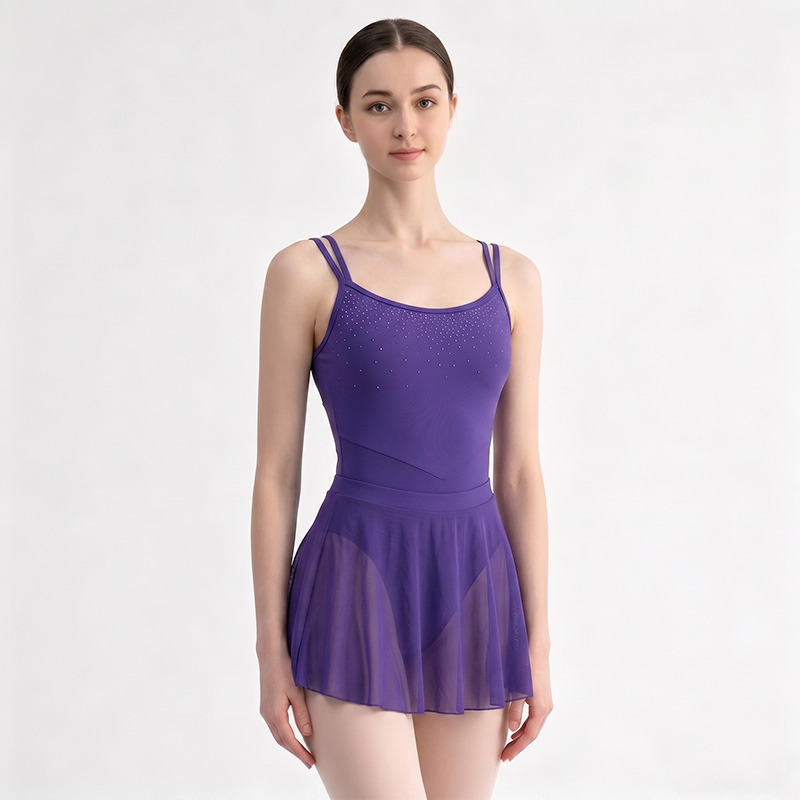
Jinwu فستان الباليه حجر الراين is a useful example of why “store the dress” is an incomplete instruction. The published material information identifies a nylon–spandex body and a polyester mesh skirt, while the product description specifies rhinestone decoration and an attached skirt. Storage has to account for all of those parts.
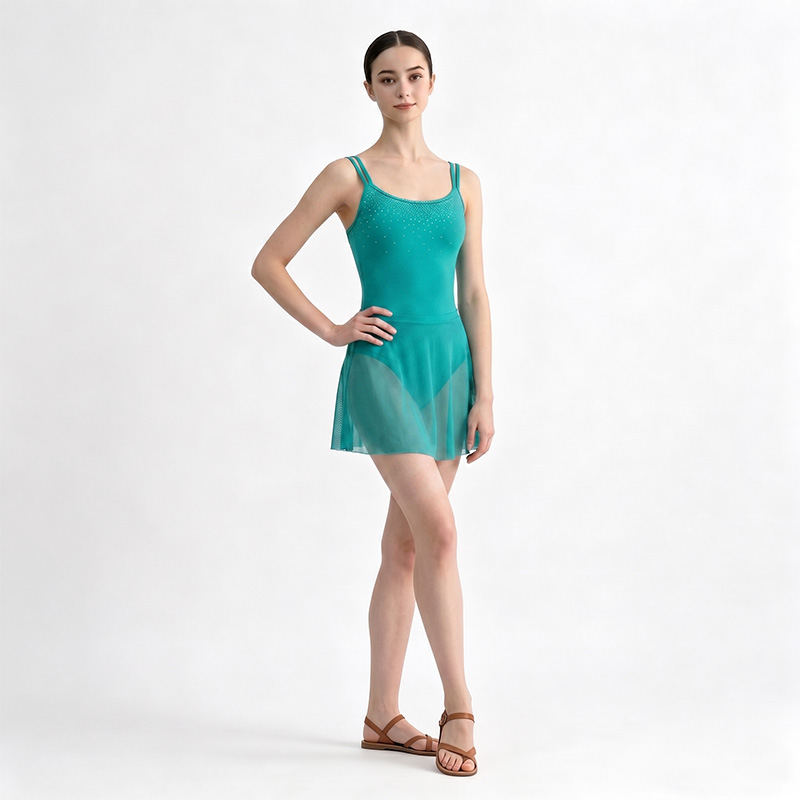
Arrange an embellished dress so that its decorated surface does not press directly against another garment’s mesh. Avoid dragging a skirt across trim when taking the dress out. If a protective layer is needed, select a clean, smooth material suitable for contact with that costume and confirm it with the supplier; a rough improvised wrapper can create another snagging surface.
Do not assume the stones are sewn, glued or heat-applied from a photograph. Ask how they are attached and whether that changes the approved cleaning, folding or storage method. The product page does not establish a tested storage temperature, stacking limit or cleaning treatment for the decoration, so none should be invented for the wardrobe instructions.
Leave enough separation that one costume can be retrieved without moving a whole row. For a school with repeated performances, individual access matters: careful storage that is awkward to use tends to become careless storage on a busy evening.
Treat tutu shape as a separate requirement
A soft skirt attached to a leotard is not the same construction as a structured stage tutu. Instructions for one should not be passed on to the other because both are described casually as ballet dresses. Ask the maker which parts maintain the skirt shape and how those parts should be supported.
There is no sensible universal instruction to hang every tutu upside down, fold every skirt in half or place every costume in a garment bag. The answer depends on construction and the space available. Where a maker specifies an orientation, photograph the correct arrangement and keep that image with the wardrobe record.
For garments stored flat, avoid squeezing the skirt into the smallest available box. The Canadian Conservation Institute’s flat-storage note explains the value of supporting the whole textile and minimising folds. Apply that principle thoughtfully rather than treating a folded skirt as finished simply because the lid closes.
If your cupboard cannot accommodate the specified shape, solve the space problem before ordering a full cast’s costumes. A dress that suits the choreography can still be impractical for a school whose only storage is a shallow, crowded shelf.
Choose a practical storage location
Choose a clean, dry location away from direct light, with sensible access for inspection. Avoid treating an intermittently used performance venue as permanent storage without checking where the costumes will actually be kept. A room that works during rehearsals may be locked, rearranged or used for equipment afterwards.
Inspect the proposed cupboard or rail with a costume in hand. Look for protruding fixings, rough shelf edges and pinch points where a door can trap fabric. Check that staff can lift a container with both hands and place it on a clear surface before opening it. Storage instructions should match the room people use.
For long gaps between productions, assign someone to inspect the collection and record the date. Choose the interval around local conditions and access rather than inventing a universal schedule. A change of room, evidence of moisture or signs of pests calls for attention immediately; it should not wait for the next fitting day.
Keep the inspection simple enough to repeat. Check the space first, then a manageable section of the collection, and note any change from the previous record. A short, dated observation is much more useful than a tick beside an instruction nobody can define.
Keep the outfit and its record together
Give each costume an identifier and record the pieces that belong to it. For an illustrative school wardrobe, one entry might list the dress, a separate overskirt and a hair accessory, along with the size label and the performer who returned them. This is a suggested workflow, not a report of a Jinwu customer project.
“Together” does not have to mean touching. A small accessory can have its own labelled compartment so it does not catch on the dress. Use the same identifier on both containers. Photographing the complete outfit makes missing pieces easier to spot without asking someone to remember last season’s styling.
Keep the care label legible and retain any supplier instructions separately. Record alterations as well as the original size. Two costumes with identical labels may fit differently after a strap adjustment, so a future fitting should not rely on the printed size alone.
Ask about storage before ordering
When comparing costumes for repeated school use, ask for the care instructions alongside the sample. Discuss whether the garment is intended to hang, what support the skirt needs and how the decoration should be protected. These are practical purchasing questions, especially when several people will share wardrobe duties.
Tell the supplier how you intend to use the garment: consecutive performances followed by a short break, weekly classes, or one production followed by months in storage. Describe the available rail or shelf space. The supplier can then address the actual arrangement instead of answering a vague request for “easy care.”
For a Jinwu dress under consideration, send the product reference and your proposed storage arrangement and request written care guidance for the finished version. If you plan to change fabric or decoration, obtain guidance for that version too; approval for an earlier sample does not settle every later change.
Check before the next issue
Before handing out costumes again, reconcile the inventory, check the recorded repairs and arrange a fitting. Storage preserves what was put away; it cannot confirm that a growing dancer still fits the same garment or that a previous alteration suits a new wearer.
Inspect fastenings, straps and decoration without stretching or pulling them unnecessarily. Check the skirt for trapped folds and compare the outfit with its reference photograph. Follow the maker’s instructions for any approved preparation before wear; do not reach for heat or steam solely because a crease is visible.
Update the record when a piece is reassigned. A reliable wardrobe process ends with the next wearer receiving a complete, checked outfit, not with the previous wearer returning a full-looking bag.
ختام
Good ballet costume storage begins with the garment’s construction and continues with a clear return process. Support the weight, protect vulnerable surfaces, keep care information accessible and check the outfit before it goes back into use. The best arrangement is one your wardrobe team can follow consistently.
أسئلة وأجوبة
Can I put a costume away straight after washing?
Only after the approved drying process is complete and the whole garment is dry, including overlapping layers. Keep anything awaiting inspection or repair separate from costumes ready to issue.
How should I clean rhinestones before storage?
Follow the finished garment’s care instructions and confirm the decoration attachment method with the maker. Do not assume that a treatment suitable for the base fabric is suitable for its stones, adhesive or trim.
Can I tumble-dry a costume so it is ready to pack away?
Use a tumble dryer only if the garment’s care instructions permit it, under the stated conditions. A storage deadline is not a reason to substitute an unapproved drying method.
Should accessories stay in the same container as the dress?
They may, provided they are separated so they cannot snag or press against the fabric. Where that is awkward, use a separate labelled compartment and cross-reference it in the costume inventory.
Does a colour name change the storage method?
Colour alone does not tell you whether a costume should hang or lie flat. Construction, weight, decoration, condition and the maker’s instructions are more useful starting points. Avoid transferring advice between garments just because both are black, pink or brown.